Save 30%! Subscribe to the Annual Plan for just $13.99/month!
Save 30%! Subscribe to the Annual Plan
for just $13.99/month!
Breathing rate monitoring for dogs

Is your dog breathing heavy?

Most heavy breathing is nothing. But it's also one of the first things to change when a dog's heart or lungs are struggling, often earlier than any other signs that something is off. The direct answer: normal after exercise, heat, excitement, or anxiety. Not normal at rest, especially while sleeping. The optimal resting breathing range for a healthy dog is roughly 15-30 breaths per minute. Keep reading to check your dog's actual breathing rate in the next 30 seconds, see the real numbers on what's actually normal, and find out how Maven catches a change before you would.

★★★★★ 4.8/5 on Trustpilot
Trusted by 10,000+ families
Try it right now

Count your dog's breathing in 30 seconds

Wait until your dog is fully relaxed or asleep. Watch their chest rise and fall, one rise and one fall counts as one breath. Tap the button below once for every breath you count. We'll do the math and tell you what the number means.

0
breaths counted
Ready when you are

This works best when your dog is fully settled or asleep, not just lying down after play or on a hot day. If they were recently active or panting from heat, wait until their breathing has calmed all the way back down before counting.

You just did this once. Maven does it for you, forever.

A manual count only tells you about this exact moment, and only if your dog stays asleep long enough for you to finish. Maven's sensor takes this same reading automatically every 15 minutes, day and night, no stopwatch, no tiptoeing, no guessing whether today's number is actually worse than last week's.

See how Maven tracks it automatically →
Could this be something more?

Abnormal breathing is also how vets catch these conditions early

Heavy or fast breathing isn't a disease on its own, it's usually a symptom of something else happening in your dog's body. These are the conditions vets check for first when a dog's resting breathing rate won't settle down.

❤️
Heart disease (murmur, MVD, CHF)

When the heart can't pump efficiently, fluid builds up around the lungs. Resting breathing rate is one of the earliest measurable signs, often rising days before a cough or lethargy shows up.

🌬️
Respiratory infections (kennel cough, pneumonia, bronchitis)

Inflamed or infected airways make every breath work harder, raising the rate even when your dog is otherwise resting quietly.

🧬
Cushing's disease

Excess cortisol drives up panting and thirst together, often before other signs like a pot-bellied appearance or thinning coat appear.

🩸
Anemia

Fewer red blood cells means less oxygen reaching tissue, so the body compensates by breathing faster and harder, even at rest.

😮‍💨
Brachycephalic airway syndrome

Bulldogs, pugs, and other flat-faced breeds have naturally narrower airways, meaning more effort behind every breath, even when they're calm.

Why is my dog breathing heavy?

The real causes, sorted by how worried to actually be

Heavy breathing shows up for a lot of reasons, and most of them are harmless. The trick is context: what was your dog doing right before, how long has it been going on, and does it ease up once they've rested and cooled down. Here's the fuller picture, organized the way a vet would actually think about it.

🏃
Normal
Exercise or play

Panting hard after a walk, run, or game of fetch is completely normal. It should ease within 10-20 minutes of rest.

☀️
Normal
Heat or a warm room

Dogs cool down by panting, not sweating. Heavy breathing in warm weather or a stuffy room is expected, as long as it resolves once they cool off. Flat-faced (brachycephalic) breeds have a much lower heat tolerance and a higher risk of heat stroke, so extra shade, AC, and caution matter more for them than for other dogs.

😊
Normal
Excitement or a dream

A visitor at the door, a car ride, or REM sleep can all trigger a short spike in breathing. It settles on its own within minutes.

⚖️
Worth watching
Extra weight or a flat face

Overweight dogs and brachycephalic breeds (bulldogs, pugs, Boston terriers) naturally work harder to breathe, even at rest. Still worth mentioning at your next check-up.

😟
Worth watching
Anxiety or stress

Thunderstorms, fireworks, vet visits, and separation can all cause heavier breathing. It should resolve once the trigger passes. If it's constant, that's worth a conversation with your vet.

❤️
Call your vet
Heart or lung disease

When the heart isn't pumping efficiently, or the lungs are inflamed or filling with fluid, breathing rate rises, often before any other symptom is visible. This is the cause vets watch for most closely.

🩹
Call your vet
Pain

Chronic pain from arthritis or an acute event such as an injury or abdominal pain can cause faster, shallower breathing as a stress response, especially at rest.

🩺
Call your vet
Anemia or another systemic illness

Low red blood cell count, Cushing's disease, and other systemic conditions can all show up first as heavier breathing, since the body is compensating for something happening elsewhere.

The Maven Study, 2026

A dog's resting breathing rate has a pattern we can see.

Vets use a simple reference point: a resting respiratory rate consistently above 30 breaths per minute is a red flag, most often for fluid building up around the lungs due to heart disease. It's a good rule, but it treats every dog the same. Here's what our own data across thousands of real dogs shows.
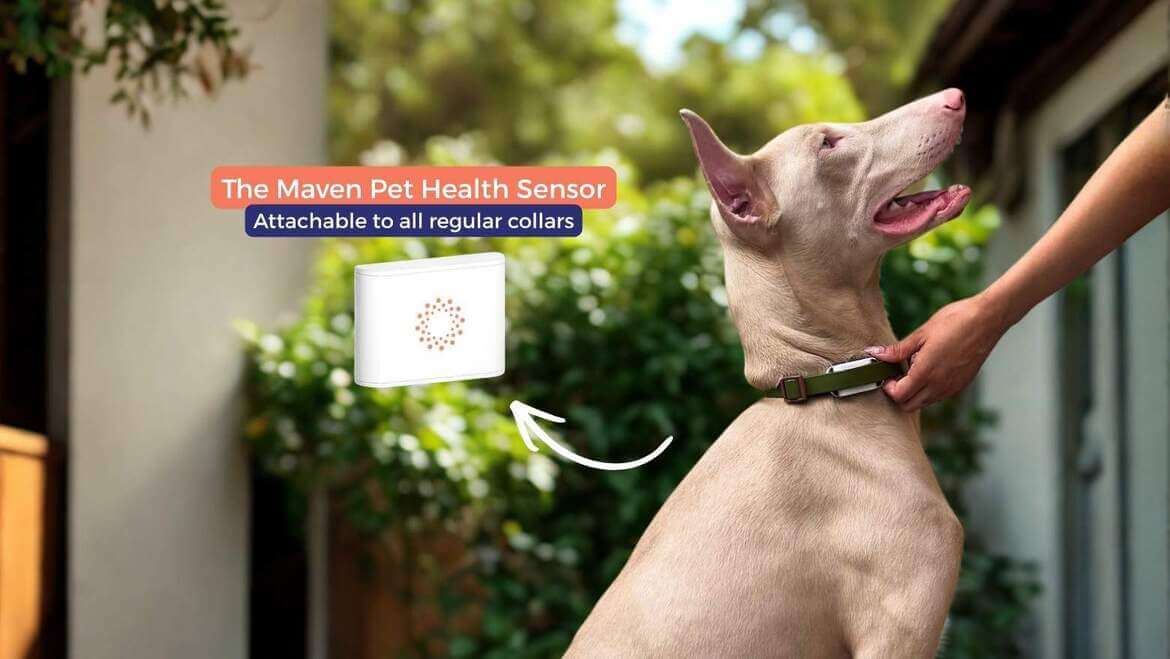
Maven Pet sensor clipped to a dog's collar
The Normal Range
14-15 bpm
is the typical resting breathing rate for a healthy dog, no matter their size.
Across 1,376 healthy dogs wearing a Maven sensor, resting respiratory rate barely changed with body size. A Chihuahua and a Great Dane land in nearly the same range at rest, roughly 11-20 breaths per minute. Size has almost nothing to do with it.
n=1,376 dogs · June 2026
The 30-Breath Line
12x
more often a dog with a heart condition crosses 30 breaths per minute at rest.
Only 0.5% of healthy dogs in Maven's dataset of 2,533 dogs ever cross 30 breaths per minute at rest. Among dogs with a known heart condition, 5.9% do, about 12 times more often, roughly 1 in 17.
n=2,533 dogs · June 2026
Heart Rate Signal
2.5x
more likely to run a persistently elevated resting heart rate with a heart condition.
Breathing rate isn't the only early signal. Dogs with a known heart condition are 2.5 times more likely to run a persistently elevated resting heart rate than healthy dogs, another change most people have no way to track from home.
n=2,382 dogs · June 2026
The 30-breath line is the safety net. You can also set your own.
Maven alerts you automatically if your dog's resting breathing rate crosses 30 breaths per minute, the clinical reference point vets use, and you can set a custom threshold for your dog specifically. Heart rate already gets a personalized baseline in the first 7 days, with a personalized breathing-rate baseline on our roadmap.
See Your Dog's Numbers →
About the data. Findings from Maven Pet's June 2026 resting respiratory rate and heart rate population studies, based on continuous at-home monitoring. 2,533 dogs analyzed for respiratory rate; 2,382 dogs analyzed for heart rate. "Healthy" means no chronic conditions declared at onboarding. "Heart condition" includes dogs with a diagnosed murmur, MVD, or CHF.
Peer-reviewed, not just self-reported

Independent researchers put Maven to the test. Here's what they found.

The Research
Does Maven's sensor actually match a manual count?
A dog wearing the Maven Pet sensor on its collar

Nineteen healthy dogs were enrolled in a peer-reviewed validation study comparing Maven's sensor reading against a manual, video-verified breath count, each pair taken within a minute of the other. The result: a bias of just -0.78 breaths per minute, well within a narrow range of agreement.

Their conclusion was direct: the sensor "could be considered to aid in monitoring the RRR in dogs, especially in dogs with poorly compliant owners because it is automated."

Read the study → Am J Vet Res · 2025
19
Healthy dogs enrolled in the validation study
120
Paired measurements comparing the sensor to a manual, video-verified count
-0.78
Breaths/min bias between the sensor and a manual count, essentially identical
Full citation. Murphy KE, Benjamin EJ, Leigh R, Adin D. "The Maven Pet Smart Collar system shows small bias compared to manually counted resting respiratory rates in healthy dogs." Am J Vet Res. 2025;87(1):ajvr.25.06.0220. DOI: 10.2460/ajvr.25.06.0220.
Manual counting vs. Maven

You just checked once. Here's what it takes to check every day.

The counter above works, for one reading, right now. But breathing rate that matters is a trend, not a single check. The instructions vets give are simple in theory: count daily, at the same time, while your dog is fully asleep. In practice, most people manage it for a few days and then life happens.

Manual counting at home
Requires catching your dog in a deep sleep without disturbing them
Dogs often wake up the second you walk over, reading ruined
One spot check gives you one data point, not a trend
You miss the overnight hours entirely, which is when changes often appear
Most people give up within a few weeks because it doesn't fit into real life
Maven Pet tracker
Clips to your dog's existing collar, runs all night without disturbing them
Lightweight sensor most dogs forget about within the first hour
Continuous readings every 15 minutes, not one spot check
Catches gradual upward trends before you'd ever notice them visually
Weekly charts ready to share at your next vet appointment
How it works

Set it up in minutes. Your dog's baseline is ready in 7 days.

1
Clip the sensor to your dog's collar

The sensor attaches to whatever collar your dog already wears. It's small and light. Most dogs stop noticing it within an hour of putting it on.

2
Maven learns your dog's heart rate baseline in 7 days

The first week, Maven builds a personalized baseline for heart rate and activity, so what counts as elevated is based on your dog specifically, not a generic average. Breathing rate is tracked continuously too, and a personalized baseline for it is on our roadmap.

3
Get an alert if breathing crosses a safe threshold

If your dog's resting readings cross 30 breaths per minute, the clinical reference point vets use, or a custom threshold you've set for your dog, you get a notification. Not a scare. A heads-up with enough time to call your vet before it becomes urgent.

4
Bring real data to your vet

Download your dog's monthly health report PDF directly from the app, or share trend charts on the spot. Show your vet actual numbers instead of "she seemed to be breathing a little heavy last week."

Real dog parents, real stories

Watch Maven in the real world

Maven Pet dog parent story
Dog parent story
Maven Pet in action
Maven in action
Maven Pet review
Pet parent review
From dog parents who've asked the same question

What people say after they started tracking their dog's breathing

Trustpilot
Excellent · 4.8 out of 5 · based on 394 verified reviews
★★★★★

"My 12-year-old was diagnosed with a heart murmur. Now I can actually see when he's within a safe resting respiratory rate or when he's creeping into unsafe territory and make a better call about what to do."

★★★★★

"After my dog's CHF diagnosis, Maven gave me the confidence to keep an eye on her breathing without living in constant panic. I just check the app instead of lying awake listening to her breathe."

Read all reviews on Trustpilot →
Common questions

Everything about heavy breathing in dogs

No. Most heavy breathing is completely normal, after exercise, in warm weather, or during excitement, and it resolves within minutes once your dog rests and cools down. It becomes worth investigating when it happens at rest, persists longer than expected, or comes with other signs like coughing, pale gums, or reluctance to lie down. Context and recovery time are what separate normal from concerning.
Most healthy dogs breathe between 11 and 20 times per minute at rest, and this barely changes with body size, a Chihuahua and a Great Dane fall in a similar range. Vets use 30 breaths per minute as the clinical line where sustained readings at rest become a concern, most often for early heart or lung disease. In Maven's own dataset of 2,533 dogs, only 0.5% of healthy dogs ever cross that line, versus 5.9% of dogs with a known heart condition.
Worry less about a single heavy-breathing episode and more about the pattern: breathing that's heavy at rest with no obvious trigger, that doesn't ease up after 20-30 minutes of calm, or that repeats night after night. Go to a vet immediately if you notice pale, blue, or gray gums, an outstretched neck, open-mouth breathing at rest, collapse, or your dog seeming unable to get comfortable. Those are emergency signs regardless of the breathing rate itself.
Wait until your dog is fully relaxed or asleep. Count each rise and fall of the chest as one breath for 30 seconds, then multiply by two to get breaths per minute. Use the counter tool on this page to do the math automatically. The catch is consistency, one reading tells you very little, and dogs often wake up the moment you walk over to check. That's the exact problem continuous monitoring solves.
Maven's sensor clips to your dog's existing collar and uses a gyroscope and accelerometer together to detect the subtle chest movement that happens with each breath. It only takes a reading after your dog has been still for a full 15 minutes, so it's measuring genuine rest, not just stillness. It builds a personalized baseline for heart rate and activity over the first 7 days. For breathing rate, it currently sends an alert if resting readings cross 30 breaths per minute, the clinical threshold vets use, or a custom threshold you set for your dog, with a personalized breathing-rate baseline on our roadmap. The accuracy has been clinically validated against video-measured readings.
No. Maven also tracks heart rate, activity, sleep quality, drinking, and head-shaking behavior, so it's useful for healthy dogs as a general wellness tool too. For dogs with a heart murmur, MVD, CHF, or a respiratory condition, breathing rate monitoring is usually the main reason people subscribe. But building a baseline while your dog is healthy is exactly what makes a future change easy to spot, instead of having nothing to compare against.
Yes. The app generates a monthly health report PDF covering all of your dog's tracked signals, or you can share trend charts directly from the app during an appointment. Bringing weeks of real breathing-rate data instead of a one-time impression changes what your vet can actually act on.
Get started

Stop counting breaths. Start tracking trends.

One sensor. One app. The breathing data your vet actually needs. Maven is $13.99 a month with the sensor included. 30-day risk-free return policy.

Most popular · Save 30%
Annual plan
$13.99/mo
Billed annually
That's $167.88/year
Get started
Monthly plan
$19.99/mo
Billed monthly
6-month minimum commitment
Get started
Everything included in both plans
24/7 resting respiratory rate monitoring
Heart rate and activity tracking
Personalized baseline for your dog
Monthly health report PDF for vet appointments
Alerts when readings go above your dog's normal range
Free worldwide shipping

Plans cover 1 pet. 2 and 3 pet options available at checkout. The sensor fits most standard collars and works for both dogs and cats.

Your next step

You don't have to guess whether this is normal.

Maven tracks your dog's breathing rate automatically, day and night, so the next time something feels off you'll have weeks of real data instead of one uncertain count. Set it up tonight, and stop lying awake listening for changes you can't reliably measure anyway.

Start for $13.99/month

30-day risk-free return policy · Free worldwide shipping · Cancel anytime