Save 30%! Subscribe to the Annual Plan for just $13.99/month!
Save 30%! Subscribe to the Annual Plan
for just $13.99/month!
Mobility & activity monitoring for dogs

Why is my dog limping?

A limp can mean anything from a stuck thorn to a torn ligament, and the two look nothing alike in how urgent they are. The direct answer: a sudden, severe limp with visible injury, or a dog who won't put any weight on the leg, needs a vet the same day. A mild, intermittent, or gradually-worsening limp is often something you can watch safely, and it's exactly the kind of pattern continuous activity tracking is built to catch early. Keep reading for the real causes sorted by how worried to be, a 30-second check for right now, and how Maven tracks your dog's activity automatically.

★★★★★ 4.8/5 on Trustpilot
Trusted by 10,000+ families
Try it right now

How worried should you actually be?

Answer a couple of quick questions about what you're seeing right now. It takes 30 seconds and gives you a real starting point, not a diagnosis.

Can your dog put any weight on the leg at all?
Any visible swelling, wound, or crying out when touched?
Did it start suddenly, or has it come on gradually / come and gone before?

This is a quick gut-check, not a diagnosis. If you're ever unsure, calling your vet costs nothing but a few minutes.

You just checked one moment. Maven tracks the pattern every day.

A quick check tells you about right now. Maven's sensor tracks your dog's activity and rest automatically, every day, and learns what's actually normal for your dog specifically, so a real decline stands out well before it looks like an obvious limp.

See how Maven tracks activity →
Could this be something more?

Limping is also how vets catch these conditions early

A limp is a symptom, not a diagnosis on its own, it's usually the visible tip of something happening deeper in a joint, bone, or nerve. These are the conditions vets check for first when a limp isn't from an obvious injury.

🦴
Hip dysplasia

A genetic condition where the hip joint doesn't fit snugly, common in larger breeds, leading to a chronic, progressive limp that often shows up gradually and worsens after exercise.

🐾
Osteoarthritis

An active inflammation in a joint that leads to cartilage degeneration over time. The chronic version most senior dogs live with day to day, sometimes distinguished as osteoarthrosis, builds up gradually and rarely fully resolves. See how Maven tracks arthritis-related activity changes →

🦵
Elbow dysplasia

A developmental mismatch in the elbow joint, mostly seen in large and giant breeds, leading to front-leg lameness that's often worse after exercise.

🎗️
An old injury or past joint surgery

A previous ligament tear, fracture, or surgery changes how weight moves through a joint, often leading to arthritis and arthrosis in that same joint years later.

🧬
Bone tumor (uncommon)

Rare, but a persistent, worsening limp in a large or giant breed with no obvious injury, especially with localized swelling, is worth ruling out with your vet.

Why is my dog limping?

The real causes, sorted by how worried to actually be

Limping shows up for a lot of reasons, and there's almost always something behind it, even when it's mild. The trick is context: which leg, how it started, and whether it's a one-off or a repeating pattern. Here's the fuller picture, organized the way a vet would actually think about it.

🦵
Normal
Leg fell asleep

Lying in one position too long can temporarily cut off circulation or nerve signal to a leg, causing an odd, wobbly limp for a minute or two after getting up. It resolves almost immediately as sensation returns.

🌿
Normal
A stuck thorn, pebble, or splinter

A quick check between the toes and paw pad often finds the culprit, especially if your dog has also been intensely licking the area. Once it's removed, the limp usually disappears right away.

🎾
Normal
Overexertion after a big day

An unusually long hike or an extra-intense play session can leave muscles sore the next day, similar to how a person feels after a hard workout. It should ease within a day or two of rest.

🩹
Worth watching
A mild sprain or strain

Landing wrong during play or running can strain a muscle, tendon, or ligament. Dogs usually still bear some weight, and it improves steadily with rest over several days rather than getting worse.

🦴
Worth watching
Luxating patella

The kneecap briefly slips out of its groove and pops back in, causing an intermittent skip or hop rather than a constant limp. Common in small breeds and worth mentioning at a check-up even if it resolves on its own.

🐾
Worth watching
Early arthritis or joint stiffness

Gradual stiffness that's more obvious after resting or on cold mornings, and eases once your dog gets moving, is a classic early arthritis pattern. It often goes unnoticed for weeks before it looks like a real limp.

🚨
Call your vet
Cruciate ligament (ACL) tear

The most common serious knee injury in dogs. It causes sudden, significant lameness, often with the dog refusing to put the leg down at all, sometimes hopping on three legs.

🦴
Call your vet
Fracture or dislocation

Usually from a fall, being stepped on, or a car accident. Look for visible swelling, an odd angle, or your dog guarding the leg completely.

🩸
Call your vet
Deep wound, embedded object, or infection

A cut, puncture, or something lodged deeper in the paw can cause sudden, severe limping along with swelling, heat, or discharge.

Same-day vet visit if you see any of these
  • Your dog completely refuses to put any weight on the leg
  • The limb looks twisted or dislocated, or has a gaping wound, significant swelling, or bleeding
  • Your dog cries, yelps, or growls when the area is touched
  • The limping is paired with lethargy, appetite loss, or general weakness
The Maven Study, 2026

A limp doesn't come out of nowhere. It leaves a trail.

Joint pain and chronic mobility issues almost always show up in daily activity before they show up as an obvious limp. Here's what our data across thousands of real dogs shows.
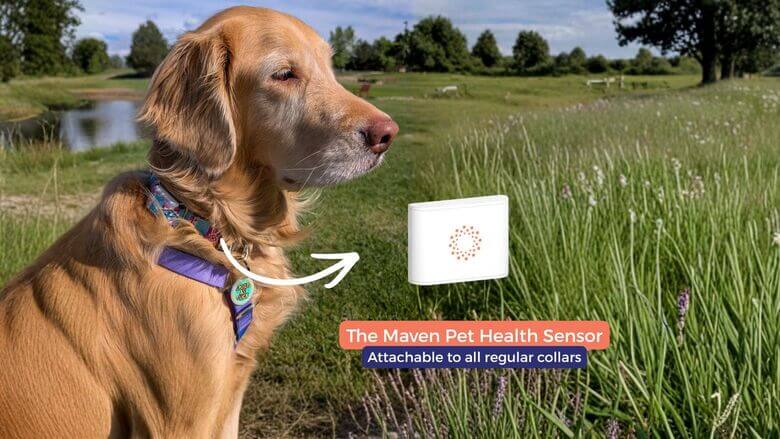
Maven Pet sensor clipped to a dog's collar
The Activity Decline
37%
less daily active time senior dogs get compared to adult dogs.
The drop persists even in healthy seniors with no diagnosed condition, so some of it is natural aging, arthrosis alone is common in senior dogs even without a visible limp. But arthrosis flare-ups and active arthritis are among the biggest drivers behind the extra decline, and a visible limp is often one of the last things to show up, not the first.
n=2,538 dogs · Maven Pet Aging Signature study, July 2026
The Activity Gap
1 in 2
dogs get less than 30 minutes of real activity a day.
Nearly half the dogs in our activity study fell short of what most vets recommend. For dogs with joint discomfort, that gap tends to widen as movement becomes harder, well before it looks like a limp on a walk.
n=2,050 dogs · Maven Pet activity study
Every Dog Has a Baseline
3×
gap in daily active time between small and large breeds.
Bichon Frises average 57 minutes of daily active time; Great Danes average just 19. Population averages aren't the point, a drift from your own dog's baseline is often the first suspicion of joint discomfort, sometimes before visible limping appears.
Maven Pet internal breed comparison, 2026
A quiet decline is easy to miss. Maven isn't.
Maven learns your dog's personal activity baseline in the first week, then flags a real drift automatically, before it turns into a limp you can't ignore.
See Your Dog's Numbers →
About the data. The 37% figure is from Maven Pet's July 2026 Aging Signature study of 2,538 dogs monitored continuously at home, isolating natural activity decline with age. The 1-in-2 and breed-comparison figures are drawn from Maven Pet's broader activity study of 2,050 dogs. "Healthy" means no chronic condition declared at onboarding. Activity is measured as active or excited seconds per collar-worn hour on days with at least 22 hours of wear.
Peer-reviewed, not just self-reported

Independent researchers put Maven to the test. Here's what they found.

The Research
Can a sensor actually catch a mobility problem before it becomes an obvious limp?
A dog wearing the Maven Pet sensor on its collar

Independent researchers, including three of Maven's own veterinarians, tracked five dogs with diagnosed osteoarthritis for up to four months using the Maven sensor's activity data, the same signal that shows up as slower starts, less play, and eventually a visible limp at home.

Nine real clinical events happened during the study. In eight of them, the sensor's activity data lined up with when the flare-up started, worsened, or improved. In one case, the drop in activity showed up before the owner noticed anything was wrong.

Read the study → Animals (MDPI) · 2025
5
Dogs monitored for up to 126 days on the Maven sensor
8/9
Clinical events where sensor deviations lined up with real symptom changes
1
Case where the sensor flagged the decline before the owner noticed
Full citation. Sacoor C, Leitão S, Domingues C, Babo J, Sá CM, Cabeças R, Queiroga FL. "Continuous Activity Monitoring Using a Wearable Sensor in Dogs with Osteoarthritis: An Exploratory Case Series." Animals. 2025;15(18):2639. DOI: 10.3390/ani15182639. Three co-authors are Maven Pet veterinarians. Funded by Maven Pet.
Watching vs. Maven

You can't watch every step. Maven does.

You already notice when your dog seems a little slower or off. That's not the problem. The problem is telling "had a rough day" apart from a real pattern, and remembering enough detail to describe it accurately at the vet.

👀
Watching and remembering
Only notice a limp once it's already visible on a walk
Hard to tell a rough day apart from a real, repeating pattern
Easy to write off a slow week as "just tired" or the weather
No record to show your vet beyond "he's been favoring that leg lately"
Misses the days activity quietly drops before the limp shows up
Maven Pet tracker
Tracks daily activity and rest continuously, without watching every step
Learns what's normal for your specific dog in the first 7 days
Flags a drift from that baseline automatically, day or night
Weekly trend charts and a monthly health report PDF ready for the vet
Tracks activity, rest, sleep, and heart rate in one place
How it works

Set it up in minutes. Your dog's baseline is ready in 7 days.

1
Clip the sensor to your dog's collar

The sensor attaches to whatever collar your dog already wears. It's small and light. Most dogs stop noticing it within an hour of putting it on.

2
Maven learns your dog's activity baseline in 7 days

The first week, Maven learns what a normal day of movement looks like for your specific dog, so a later alert actually means something.

3
Get a heads-up if activity drifts

If your dog's daily activity or rest pattern drifts from their own normal, you get a notification, often before a limp is obvious on a walk.

4
Bring real data to your vet

Download your dog's monthly health report PDF directly from the app, or share trend charts on the spot. Show your vet actual data instead of "he's seemed slower lately."

Real dog parents, real stories

Watch Maven in the real world

Maven Pet dog parent story
Dog parent story
Maven Pet in action
Maven in action
Maven Pet review
Pet parent review
From dog parents who've asked the same question

What people say after they started tracking activity

Trustpilot
Excellent · 4.8 out of 5 · based on 461 verified reviews
★★★★★

"My 8-year-old Pomeranian started showing some concerning signs with his health. First epilepsy, then he started limping and getting slower every day. We were constantly concerned, so we started looking for a solution, and that's when we found Maven."

★★★★★

"After her first arthritis flare-up, the data from Maven showed a clear decline in her activity, which helped me realize something was wrong much earlier than I would have on my own. I used the reports during her vet visit, and it made the whole process faster and more accurate."

Read all reviews on Trustpilot →
Common questions

Everything about a limping dog

A limp means your dog can't put full, comfortable weight on one or more legs, and it's a pain or weakness signal rather than a specific diagnosis on its own. Common causes range from something small and self-resolving, like a stuck thorn or a leg that's fallen asleep, to sprains, arthritis, hip dysplasia, or a torn ligament. The single most useful thing to notice is whether it came on suddenly or gradually, since that alone points toward very different causes.
Call your vet the same day if your dog completely refuses to bear any weight on the leg, the limb looks twisted, dislocated, or has a gaping wound, significant swelling, or bleeding, your dog cries, yelps, or growls when the area is touched, or the limping is paired with lethargy or appetite loss. Everything else can usually be watched at home for 24 hours first.
This is one of the more common ways owners describe an intermittent limp, and it often points to something like a luxating patella (the kneecap briefly slipping out of place and back), a mild soft-tissue strain, or early joint stiffness that isn't acutely painful yet. It's still worth mentioning at your next vet visit, especially if it keeps happening, since gradual, low-pain limping is exactly the pattern that's easy to write off until it's more advanced.
Sudden limping usually points to trauma: a sprain, strain, fracture, or an injury from play, running, or a fall. Gradual limping that builds over weeks, or comes and goes, more often points to a chronic cause like arthritis, hip or elbow dysplasia, or an old injury catching up with your dog. The gradual kind is also the hardest to catch early by watching alone, since it can look like just a slow day for a while before it's obviously a limp.
Maven won't tell you what's causing a limp, only a vet exam and imaging can do that. What it does is track your dog's daily activity, rest, and sleep continuously, so a real decline, the kind that often shows up before a limp becomes obvious or a flare-up gets bad, stands out from a normal day. That turns "he's seemed slower lately" into an actual trend you can show your vet.
No. Arthritis is one of the most common causes of gradual, intermittent limping, especially in middle-aged and senior dogs, but plenty of limps come from something acute and unrelated to joint inflammation, like a paw injury, a sprain, or a torn ligament. The pattern matters: arthritis-related limping tends to build slowly and often gets worse after rest or exercise, rather than appearing suddenly.
If there are no emergency signs, you can restrict your dog to short leashed bathroom walks, examine the paw pad and toes for anything visible, and apply a cold compress to any localized swelling for 10-15 minutes a few times a day. Don't give human pain medication, force exercise, or handle the leg roughly. If the limp persists or worsens after 24 hours, call your vet.
Get started

Stop wondering. Start tracking their activity.

One sensor. One app. The mobility data your vet actually needs. Maven is $13.99 a month with the sensor included. 30-day risk-free return policy.

Most popular · Save 30%
Annual plan
$13.99/mo
Billed annually
That's $167.88/year
Get started
Monthly plan
$19.99/mo
Billed monthly
6-month minimum commitment
Get started
Everything included in both plans
24/7 activity and mobility monitoring
Heart rate and respiratory rate tracking
Personalized baseline for your dog
Monthly health report PDF for vet appointments
Alerts when readings go above your dog's normal range
Free worldwide shipping

Plans cover 1 pet. 2 and 3 pet options available at checkout. The sensor fits most standard collars and works for both dogs and cats.

Your next step

Don't wait for the limp to become obvious.

Maven tracks your dog's daily activity and rest automatically, so if a real decline is building, you'll see it in the data long before it looks like a limp on a walk. Set it up tonight.

Start for $13.99/month

30-day risk-free return policy · Free worldwide shipping · Cancel anytime