Why is my dog limping?
A limp can mean anything from a stuck thorn to a torn ligament, and the two look nothing alike in how urgent they are. The direct answer: a sudden, severe limp with visible injury, or a dog who won't put any weight on the leg, needs a vet the same day. A mild, intermittent, or gradually-worsening limp is often something you can watch safely, and it's exactly the kind of pattern continuous activity tracking is built to catch early. Keep reading for the real causes sorted by how worried to be, a 30-second check for right now, and how Maven tracks your dog's activity automatically.
How worried should you actually be?
Answer a couple of quick questions about what you're seeing right now. It takes 30 seconds and gives you a real starting point, not a diagnosis.
This is a quick gut-check, not a diagnosis. If you're ever unsure, calling your vet costs nothing but a few minutes.
A quick check tells you about right now. Maven's sensor tracks your dog's activity and rest automatically, every day, and learns what's actually normal for your dog specifically, so a real decline stands out well before it looks like an obvious limp.
See how Maven tracks activity →Limping is also how vets catch these conditions early
A limp is a symptom, not a diagnosis on its own, it's usually the visible tip of something happening deeper in a joint, bone, or nerve. These are the conditions vets check for first when a limp isn't from an obvious injury.
A genetic condition where the hip joint doesn't fit snugly, common in larger breeds, leading to a chronic, progressive limp that often shows up gradually and worsens after exercise.
An active inflammation in a joint that leads to cartilage degeneration over time. The chronic version most senior dogs live with day to day, sometimes distinguished as osteoarthrosis, builds up gradually and rarely fully resolves. See how Maven tracks arthritis-related activity changes →
A developmental mismatch in the elbow joint, mostly seen in large and giant breeds, leading to front-leg lameness that's often worse after exercise.
A previous ligament tear, fracture, or surgery changes how weight moves through a joint, often leading to arthritis and arthrosis in that same joint years later.
Rare, but a persistent, worsening limp in a large or giant breed with no obvious injury, especially with localized swelling, is worth ruling out with your vet.
The real causes, sorted by how worried to actually be
Limping shows up for a lot of reasons, and there's almost always something behind it, even when it's mild. The trick is context: which leg, how it started, and whether it's a one-off or a repeating pattern. Here's the fuller picture, organized the way a vet would actually think about it.
Lying in one position too long can temporarily cut off circulation or nerve signal to a leg, causing an odd, wobbly limp for a minute or two after getting up. It resolves almost immediately as sensation returns.
A quick check between the toes and paw pad often finds the culprit, especially if your dog has also been intensely licking the area. Once it's removed, the limp usually disappears right away.
An unusually long hike or an extra-intense play session can leave muscles sore the next day, similar to how a person feels after a hard workout. It should ease within a day or two of rest.
Landing wrong during play or running can strain a muscle, tendon, or ligament. Dogs usually still bear some weight, and it improves steadily with rest over several days rather than getting worse.
The kneecap briefly slips out of its groove and pops back in, causing an intermittent skip or hop rather than a constant limp. Common in small breeds and worth mentioning at a check-up even if it resolves on its own.
Gradual stiffness that's more obvious after resting or on cold mornings, and eases once your dog gets moving, is a classic early arthritis pattern. It often goes unnoticed for weeks before it looks like a real limp.
The most common serious knee injury in dogs. It causes sudden, significant lameness, often with the dog refusing to put the leg down at all, sometimes hopping on three legs.
Usually from a fall, being stepped on, or a car accident. Look for visible swelling, an odd angle, or your dog guarding the leg completely.
A cut, puncture, or something lodged deeper in the paw can cause sudden, severe limping along with swelling, heat, or discharge.
- Your dog completely refuses to put any weight on the leg
- The limb looks twisted or dislocated, or has a gaping wound, significant swelling, or bleeding
- Your dog cries, yelps, or growls when the area is touched
- The limping is paired with lethargy, appetite loss, or general weakness
A limp doesn't come out of nowhere. It leaves a trail.
Joint pain and chronic mobility issues almost always show up in daily activity before they show up as an obvious limp. Here's what our data across thousands of real dogs shows.
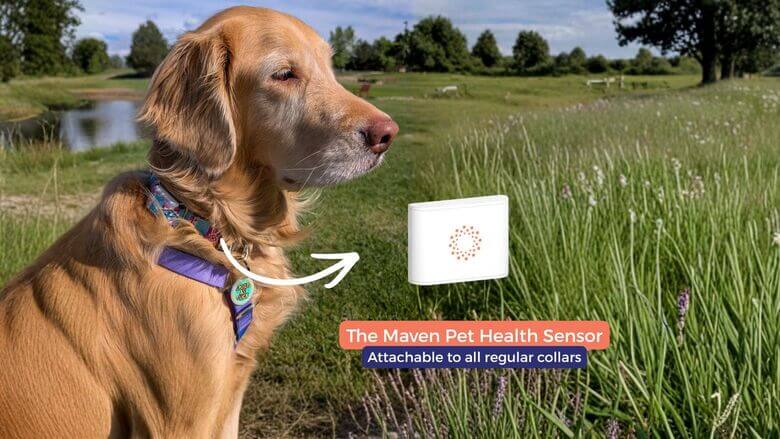
Independent researchers put Maven to the test. Here's what they found.

Independent researchers, including three of Maven's own veterinarians, tracked five dogs with diagnosed osteoarthritis for up to four months using the Maven sensor's activity data, the same signal that shows up as slower starts, less play, and eventually a visible limp at home.
Nine real clinical events happened during the study. In eight of them, the sensor's activity data lined up with when the flare-up started, worsened, or improved. In one case, the drop in activity showed up before the owner noticed anything was wrong.
You can't watch every step. Maven does.
You already notice when your dog seems a little slower or off. That's not the problem. The problem is telling "had a rough day" apart from a real pattern, and remembering enough detail to describe it accurately at the vet.
Set it up in minutes. Your dog's baseline is ready in 7 days.
The sensor attaches to whatever collar your dog already wears. It's small and light. Most dogs stop noticing it within an hour of putting it on.
The first week, Maven learns what a normal day of movement looks like for your specific dog, so a later alert actually means something.
If your dog's daily activity or rest pattern drifts from their own normal, you get a notification, often before a limp is obvious on a walk.
Download your dog's monthly health report PDF directly from the app, or share trend charts on the spot. Show your vet actual data instead of "he's seemed slower lately."


What people say after they started tracking activity
"Binx used to limp sometimes, and I'd stress wondering if I overdid our walks. Now I see when his activity dips, so I can give him extra rest days. I feel so much calmer knowing I'm doing right by him."
"My 8-year-old Pomeranian started showing some concerning signs with his health. First epilepsy, then he started limping and getting slower every day. We were constantly concerned, so we started looking for a solution, and that's when we found Maven."
"After her first arthritis flare-up, the data from Maven showed a clear decline in her activity, which helped me realize something was wrong much earlier than I would have on my own. I used the reports during her vet visit, and it made the whole process faster and more accurate."
Everything about a limping dog
Stop wondering. Start tracking their activity.
One sensor. One app. The mobility data your vet actually needs. Maven is $13.99 a month with the sensor included. 30-day risk-free return policy.
Plans cover 1 pet. 2 and 3 pet options available at checkout. The sensor fits most standard collars and works for both dogs and cats.
Don't wait for the limp to become obvious.
Maven tracks your dog's daily activity and rest automatically, so if a real decline is building, you'll see it in the data long before it looks like a limp on a walk. Set it up tonight.
Start for $13.99/month30-day risk-free return policy · Free worldwide shipping · Cancel anytime