Save 30%! Subscribe to the Annual Plan for just $13.99/month!
Save 30%! Subscribe to the Annual Plan
for just $13.99/month!
Senior dog monitoring

Signs of aging in dogs, and how to spot them early.

Dogs are considered senior between age 6 and 10, depending on breed size. The earliest signs of aging show up in daily activity, resting heart rate, breathing, and thirst, often months before you'd notice visually. Maven Pet's sensor clips onto your dog's existing collar and tracks these signals 24/7, across the 2,538 dogs we've studied and counting.

★★★★★ 4.8/5 on Trustpilot
Trusted by 10,000+ families
Maven Pet App · Activity Insights
Daily activity score
Adult dogs vs. senior dogs
376238-37%AdultSeniorMedian daily activity, adult vs. senior dogs
Your dog's baseline
Set in 7 days
Tracking
24/7, continuously
Alert example
Activity down 18% from your dog's baseline this week
The Maven Study, 2026

Aging in dogs isn't a guess anymore. We can see it happening.

Across 2,538 dogs wearing the Maven Pet sensor, three signals shifted consistently between adult and senior years. These changes appeared even in dogs with no diagnosed condition, so they're age-related, not disease-only. Here's what changed.
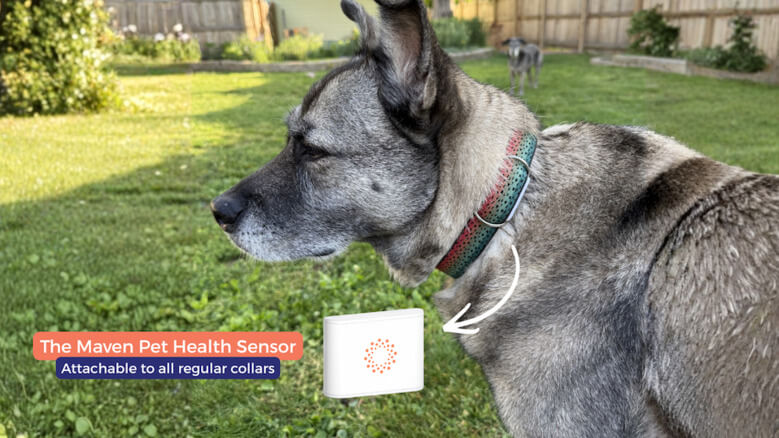
Dog wearing a collar with the Maven Pet sensor attached
The Activity Drop
-37%
Senior dogs move 37% less each day than adult dogs.
The drop appears even in dogs with no diagnosed condition, so this is aging, not just illness. When your own dog's activity dips below their personal baseline, the Maven Pet sensor flags it.
The Drinking Signal
+93%
Senior dogs drink nearly twice as much as adult dogs.
Even healthy seniors show a 33 to 45% rise. Increased thirst is also an early sign of kidney disease, diabetes, and Cushing's, all more common with age.
The Vitals Shift
+11%
Resting heart rate climbs 11% from adult to senior years.
Small, steady changes in resting heart rate are often the earliest cardiac signal. Continuous tracking is what makes those changes visible before symptoms appear.
The senior years show up in the data before they show up in the yard.
Maven Pet learns your dog's personal baseline in the first 7 days, then tracks it 24/7. If your dog is starting to drift, you'll see it long before your next vet visit.
See Your Dog's Numbers →
About the data. Based on continuous monitoring of 2,538 dogs wearing the Maven Pet sensor between August 2025 and June 2026. "Healthy" means no chronic condition declared at onboarding.
Signs to watch for

Signs of aging in dogs that are easy to miss.

You see your dog every day, which is exactly why slow drift is so easy to miss. A little less activity this month, a little more water next month, nothing dramatic enough to notice on its own. These are the four changes that showed up most consistently in Maven Pet's data, roughly in the order dog parents catch them.

😮‍💨

Panting more than they used to

Some increase in panting is a normal part of aging, especially in warm weather or after activity. But a rising resting breathing rate, or panting at rest with no obvious trigger, can also be an early sign of heart or pain-related changes. Maven Pet's sensor tracks resting respiratory rate continuously, so you know whether it's a trend or a one-off.

💧

Drinking noticeably more water

Across Maven Pet's data, drinking time nearly doubles by the advanced senior years, and it rises even in dogs with no diagnosed condition. Increased thirst is also a hallmark of kidney disease, diabetes, and Cushing's disease, all of which become more common with age.

🐕

Slower on walks, less interested in play

A senior dog who tires faster or skips the last stretch of the walk they used to handle easily isn't just "getting lazy." Maven Pet's data shows a 20 to 37% drop in daily activity by the senior years. Tracking it over time turns a vague feeling into an actual trend line you can act on.

🌀

Restless at night, or pacing and circling

Occasional restlessness can come from joint discomfort or a less restful night. But new, persistent pacing, circling, or seeming disoriented (especially in the evening) can also point to canine cognitive dysfunction, sometimes called doggy dementia or sundowners.

Why continuous monitoring matters

Why senior dogs benefit most from monitoring between vet visits.

Senior dogs rack up more consistent tracking days than any other life stage, because home health monitoring is exactly what senior dog parents already want. That's not a hunch, it's why this group keeps the Maven Pet sensor on longer than anyone else.

Here's the gap it closes: a vet visit gives you one data point. A gradual 5% drop in activity, or three days of slightly elevated breathing, is invisible to anyone who isn't tracking continuously. That gap between appointments is exactly where early senior changes are easiest to catch, and easiest to act on.

📊

Build a real baseline before symptoms show

The earlier you start, the more useful the data. A dog's "normal" is personal, not a generic number, and Maven Pet learns it in the first 7 days so future changes are measured against your dog, not an average.

💊

Track how a new medication or diagnosis is going

Chronic condition rates climb sharply with age, about 20% of adults vs. 54 to 61% of senior dogs. Maven Pet's trend data shows whether a new medication is working, not just whether your dog seems okay in the exam room.

📋

Bring real data to every vet visit

"They've been a little more tired lately" is hard for any vet to act on. Weeks of actual trend data on activity, heart rate, breathing rate, and drinking gives your vet something concrete to work with at every senior wellness check.

🔔

Get a heads-up, not a scare

Maven Pet alerts you when a reading drifts from your dog's own normal range. Not a panic notification, just a heads-up with enough time to call your vet before a gradual change becomes an urgent one.

From people monitoring a senior dog right now

What senior dog parents say about Maven Pet

Trustpilot
Excellent · 4.8 out of 5 · based on 394 verified reviews
★★★★★

"I have a tracker on his respiratory rates, now heart, and a report on how much he's sleeping and drinking. Especially with kidney failure always being a concern with these guys, it helps me know he is keeping up with his water intake, and his activity report gives me an idea of his quality of life."

★★★★★

"I have a senior dog with some health issues. This app allows me to know when he is stressed or overexerting himself. I can respond to his needs better by observing changes in the app stats, and get a heads-up if he is starting to experience any issues."

Read all reviews on Trustpilot
Peer-reviewed, not just self-reported

Independent researchers put Maven Pet to the test. Here's what they found.

The Research

Does the sensor actually catch a flare-up in real life?
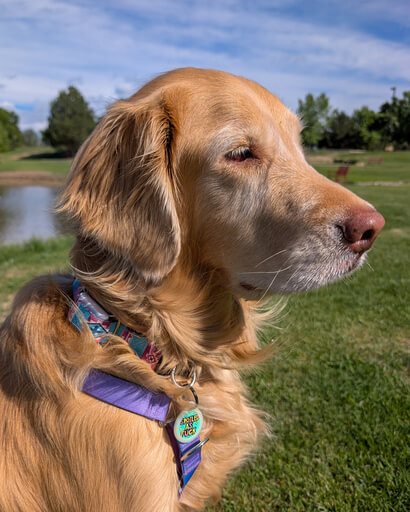
A senior dog with osteoarthritis wearing a Maven Pet sensor

Osteoarthritis is one of the most common conditions in senior dogs, and flare-ups are notoriously easy to miss day to day. Independent researchers, including three of Maven Pet's own veterinarians, tracked five dogs with diagnosed OA for up to four months using the Maven Pet sensor.

Nine real clinical events happened during the study. In eight of them, the sensor's activity data lined up with when the flare-up started, worsened, or improved. In one case, the drop in activity showed up before the owner noticed anything was wrong.

Read the study Animals (MDPI) · September 2025
5
Dogs monitored for up to 126 days on the Maven Pet sensor
8/9
Clinical events where sensor deviations lined up with real symptom changes
1
Case where the sensor flagged the decline before the owner noticed
Full citation. Sacoor C, Leitão S, Domingues C, Babo J, Sá CM, Cabeças R, Queiroga FL. "Continuous Activity Monitoring Using a Wearable Sensor in Dogs with Osteoarthritis: An Exploratory Case Series." Animals. 2025;15(18):2639. DOI: 10.3390/ani15182639. Three co-authors are Maven Pet veterinarians. Funded by Maven Pet.
Watching and hoping vs. Maven Pet

You know your dog better than anyone. That's not the same as data.

Most dog parents catch senior changes the same way: a feeling that something's a little off, checked against memory of how their dog used to be. It works eventually, usually right after the change is already obvious. Maven Pet catches the same changes while they're still small.

👀
Watching and remembering
Relies on noticing a slow drift against your memory of "normal"
Easy to explain away single off days as heat, mood, or a bad night's sleep
No record to show your vet beyond "they've seemed a bit different lately"
By the time a change is visible to the eye, it's often been building for weeks
Misses overnight changes entirely, when breathing and rest issues often show up first
Maven Pet sensor
Clips to your dog's existing collar, tracks continuously without disturbing them
Learns your specific dog's personal baseline in the first 7 days
Flags drift from that baseline automatically, day or night
Weekly trend charts and a monthly health report PDF ready for every vet visit
Tracks activity, heart rate, respiratory rate, and drinking in one place
How it works

Set it up in minutes. Your dog's baseline is ready in 7 days.

1
Clip the sensor to your dog's collar

Attaches to whatever collar your dog already wears. Small, light, and most dogs stop noticing it within an hour.

2
Maven Pet builds your dog's personal baseline in 7 days

Every senior dog ages differently. The first week, Maven Pet learns what normal looks like for your specific dog, at their current stage, so later alerts mean something.

3
Get alerted when something shifts

If activity, heart rate, breathing rate, or drinking drifts from your dog's personal normal, you get a notification with enough time to act before it becomes urgent.

4
Bring real data to every senior wellness visit

Download a monthly health report PDF covering activity, heart rate, breathing rate, and sleep. Walk in with actual trend data instead of a vague impression.
Real dog parents, real stories

Watch Maven Pet in the real world

Maven Pet dog parent story
Dog parent story
Maven Pet in action
Maven Pet in action
Maven Pet review
Pet parent review
Common questions

Everything about caring for a senior dog at home

It depends heavily on breed size. Small and toy breeds are typically considered senior around age 10 to 11, medium breeds around 8 to 9, and large or giant breeds as early as 6 to 7, since bigger dogs age faster. There's no single universal number, which is part of why watching for actual physical changes, rather than just counting birthdays, matters more as your dog gets older.
The earliest signs tend to be the least dramatic: slightly less enthusiasm for walks, a bit more panting at rest, drinking a little more water, sleeping a little differently. None of these look alarming on their own, which is exactly why they're easy to miss without something tracking the trend. More visible signs, like graying fur, cloudy eyes, or stiffness getting up, tend to show up later.
Some increase in both is a normal part of aging. In Maven's own fleet data, drinking time rises 33 to 45% in healthy senior dogs with no diagnosed condition, and resting breathing rate rises as well in early seniors. That said, a sharp or sudden increase in either, especially drinking, can also signal kidney disease, diabetes, or Cushing's disease, all more common in older dogs. If the change is new, sudden, or significant, mention it to your vet rather than assuming it's just age.
This can have several causes. Joint discomfort or reduced mobility can make it harder for a senior dog to settle. It can also be an early sign of canine cognitive dysfunction, sometimes called doggy dementia or sundowners syndrome, particularly if it's new, happens mostly in the evening, or comes with disorientation or getting "stuck" in corners. If this behavior is new and persists for more than a few days, it's worth describing to your vet in detail rather than waiting to see if it passes.
Maven's sensor clips to your dog's existing collar and continuously tracks resting respiratory rate, heart rate, activity, and other signals, then builds a personalized baseline over the first 7 days. For senior dogs, this means catching gradual changes while they're still small, a slow drop in activity, a rising resting breathing rate, increased drinking, rather than waiting until they're obvious. You get an alert when something drifts from your own dog's normal range, and a monthly health report PDF to bring to vet visits.
No, and it's not meant to. Senior dogs generally need more frequent vet visits, not fewer, since chronic conditions become much more common with age. Maven fills the gap between those visits, so your vet has real trend data to work with rather than a single snapshot, and so you're not relying on memory to notice when something's changed. Think of it as a continuous layer of information that supports your vet's care, not a substitute for it.
Maven's sensor clips to your dog's existing collar and uses a gyroscope and accelerometer together to detect movement, chest motion, and activity patterns. It builds a personalized baseline over the first 7 days of wear and flags readings that deviate from your dog's own normal range going forward. Accuracy has been clinically validated in peer-reviewed research.
Get started

Start monitoring your senior dog tonight

Maven Pet is $13.99 a month with the sensor included. 30-day risk-free return policy.

Most popular · Save 30%
Annual plan
$13.99/mo
Billed annually
That's $167.88/year
Get started
Monthly plan
$19.99/mo
Billed monthly
6-month minimum commitment
Get started
Everything included in both plans
24/7 activity and vitals monitoring
Heart rate and respiratory rate tracking
Personalized baseline for your dog
Monthly health report PDF for vet appointments
Alerts when readings go above your dog's normal range
Free worldwide shipping

Plans cover 1 pet. 2 and 3 pet options available at checkout. The sensor fits most standard collars and works for both dogs and cats.

Related conditions more common in senior dogs
Heart murmur in dogs
A common finding at senior wellness exams, and what it means for monitoring
Mitral valve disease (MVD)
The most common heart condition in aging dogs, signs and home monitoring
Congestive heart failure in dogs
CHF stages and managing breathing at home as dogs age
Dog respiratory rate tracker
How Maven Pet monitors breathing rate continuously with the sensor
From the Maven Pet blog

Keep learning about caring for a senior dog

Everything from figuring out when your dog is officially a senior, to spotting cognitive changes, to feeding and exercising an aging body. Written by our in-house veterinarians.

Browse all senior dog health articles
Your next step

The senior years go by fast. Don't just watch them happen.

Aging in dogs is gradual and easy to miss day to day. Maven Pet tracks activity, heart rate, breathing rate, and more automatically, so you catch what's changing before it becomes a bigger problem. Set it up tonight.

Start for $13.99/month

30-day risk-free return policy · Free worldwide shipping · 6-month minimum commitment