
Exercise Induced Collapse in Dogs: Signs & Safety (Vet Verified)

Watching your dog suddenly collapse during a training session is one of the most frightening experiences a pet owner can face. If your pup has collapsed during exercise, you may be dealing with a condition called exercise-induced collapse in dogs (EIC). The good news is that most dogs recover fully, and with the right knowledge, you can keep them safe.
What Is Exercise Induced Collapse in Dogs?
Exercise-induced collapse in dogs (EIC) is a genetic condition that is inherited from the parents. It most commonly affects Labrador Retrievers and related breeds. While episodes are alarming, most dogs recover within 5–25 minutes. EIC is manageable with activity limits, but exercise must stop immediately at the first sign of weakness to prevent serious complications.
Key Takeaways
- EIC is a hereditary condition caused by a mutation in the DNM1 gene
- Symptoms typically appear in dogs under 3 years of age
- Episodes usually last 5–25 minutes, after which dogs return to normal
- EIC can rarely be fatal — always stop exercise at the first sign of wobbliness
- There is no cure, but careful activity management allows most dogs to live full, happy lives
- Early detection of changes in stamina, recovery time, and potentially resting respiratory rate can help prevent collapse episodes
Exercise Induced Collapse in Dogs, Explained

Exercise induced collapse in dogs is a genetic neuromuscular disorder that causes muscle weakness, loss of coordination, and collapse following intense exercise in otherwise healthy-looking dogs. It is caused by a genetic mutation, which affects how nerve signals control muscle function during exertion.
Affected dogs appear completely normal at rest and can tolerate mild to moderate activity without any problems. However, after 5 to 20 minutes of strenuous exercise — or during highly exciting activities — the nervous system’s ability to maintain muscle control breaks down, leading to an episode.
“”EIC episodes can feel sudden and unpredictable, but dogs with this condition often show gradual shifts in how they tolerate and recover from activity. Having a continuous record of your dog’s normal patterns — their resting respiratory rate, heart rate, and daily activity — gives you and your vet something concrete to work with when something starts to feels off.” — Sara Leitão, DVM, Veterinarian at Maven Pet
What Are the Symptoms of EIC in Dogs?
Symptoms typically begin in the hind limbs and can progress anteriorly if exercise continues. Warning signs include:
- Wobbly or wide-legged gait — often the first visible sign
- Hind limb weakness or dragging — legs lose the ability to support body weight
- Progressive loss of coordination — spreading from back to front limbs
- Complete collapse — the dog is unable to stand or move
- Disoriented or dazed appearance — though most dogs remain conscious and alert
- Elevated body temperature — during an episode, temperatures can reach 41–42°C (107–108°F) in some dogs
- Panting — as the body attempts to release heat
Critically, symptoms often continue to worsen for 3 to 5 minutes even after exercise has stopped.
“I got the Maven sensor for my 14-year-old Chihuahua mix with heart and trachea issues. It gave me back peace of mind – I can track her RRR, BPM, drinking, and activity anytime and know instantly if something’s wrong. Highly recommend!”

★★★★★
Chiara De Luca
Titti
Is Exercise-Induced Collapse in Dogs Fatal?
This is one of the most common questions dog owners ask — and the honest answer is: rarely, but yes, it can be.
Most dogs recover fully within 5 to 25 minutes after an episode, returning to their normal selves without any lasting effects. However, a small number of dogs have died during or immediately after a collapse, even dogs not previously considered severely affected.
The key risk factor is continuing exercise after the first signs appear. Dogs that keep running — or are encouraged to push through — face a significantly higher risk of a life-threatening episode. The moment you notice an abnormal gait or wobbling, stop all activity immediately.
EIC does not shorten a dog’s lifespan when properly managed. With appropriate exercise limits and monitoring, the vast majority of affected dogs go on to live normal, healthy lives.
What Causes Exercise-Induced Collapse?
EIC is caused by an inherited mutation in the dynamin-1 (DNM1) gene. Dynamin-1 is a protein essential for maintaining nerve signal transmission during intense muscle activity. When the gene is mutated, this signaling breaks down under the demands of strenuous exercise.
Several factors make an episode more likely:
- Extrenuous or prolonged exercise — particularly high-drive activities like retrieving, field trials, or agility
- High excitement levels — emotional arousal plays a significant role in triggering episodes
- Warm or humid weather — elevated ambient temperatures increase the likelihood of collapse
- Young age — most dogs show first symptoms between 5 months and 3 years of age (average: 14 months)
Which Dogs Are at Risk for EIC?

EIC is most prevalent in Labrador Retrievers — particularly those from working or sports — but it has been identified across several breeds. Dogs at elevated risk include:
- Labrador Retrievers (all colors)
- Boykin Spaniels
- Cocker Spaniels (American and English)
- Chesapeake Bay Retrievers
- Curly-Coated Retrievers
- German Wirehaired Pointers
- Cardigan Welsh Corgis
- Old English Sheepdogs
- Bouvier des Flandres
- Labradoodles and other Lab crosses
Affected dogs are often described as highly fit, muscular, and energetic — the very traits that make them excellent working dogs. This is part of why EIC can go undetected until the first episode.
If your dog is a high-risk breed and leads an active lifestyle, genetic testing is strongly recommended. A simple cheek swab can determine whether your dog is clear, a carrier, or affected.
What Should You Do If Your Dog Collapses After Exercise?
Stay calm. Your response in the minutes following a collapse matters greatly. It’s of utmost importance to distinguish an episode of exercise-induced collapse and a heat stroke. A Heat Stroke is an emergency and requires immediate veterinary attention. Here’s what to do:
- Stop all exercise immediately — at the very first sign of wobbling, don’t wait
- Move to a calm, cool environment — to reduce stimulation and lower body temperature
- Ensure airways are clear — allow your dog to pant freely to release heat
- Observe gum color — if red gums or tongue call your vet immediately as this can be a sign of a heat stroke
- Observe alertness— if your dog is unconscious they require veterinary attention
- Offer water or ice — let them drink if they are conscious and able
- Cool them down gently — wet their coat, especially on the belly and paws
- Do not force them to move — let recovery happen at their own pace
- Monitor closely — most dogs recover in 5–25 minutes; if symptoms persist beyond 30 minutes or are severe and followed by vomiting or seizures, seek emergency veterinary care immediately
- Call your vet — even after a full recovery, report the episode and discuss next steps
After the episode, arrange a full veterinary evaluation including a physical exam, bloodwork, and possible genetic testing to confirm EIC as the cause. According to MSD Veterinary Manual some nervous reflexes, particularly the patellar reflex, might be decreased or absent in EIC dogs which can help vets differentiate the condition from other problems.
How Can You Prevent Exercise-Induced Collapse?
While there is no cure for EIC, collapse episodes can be prevented through careful management:
- Avoid high-intensity, high-excitement activities — retrieve games, field trials, agility runs, and similar activities are common triggers
- Stick to moderate, consistent exercise — short walks and calm play are generally safe
- Exercise in cooler temperatures — avoid midday heat and humid conditions
- Watch for early warning signs — any sign of fatigue, stumbling, or reduced tolerance should prompt you to stop immediately
- Test breeding dogs — if you are a breeder, DNA testing all breeding stock is essential to prevent producing affected puppies
- Build a health baseline — tracking your dog’s normal activity levels, heart rate, and recovery patterns makes it far easier to detect subtle changes.
How Maven Helps
One of the greatest challenges with EIC is that episodes often seem to come out of nowhere — but in many cases, subtle changes in exercise tolerance may appear in the days or weeks before a collapse.

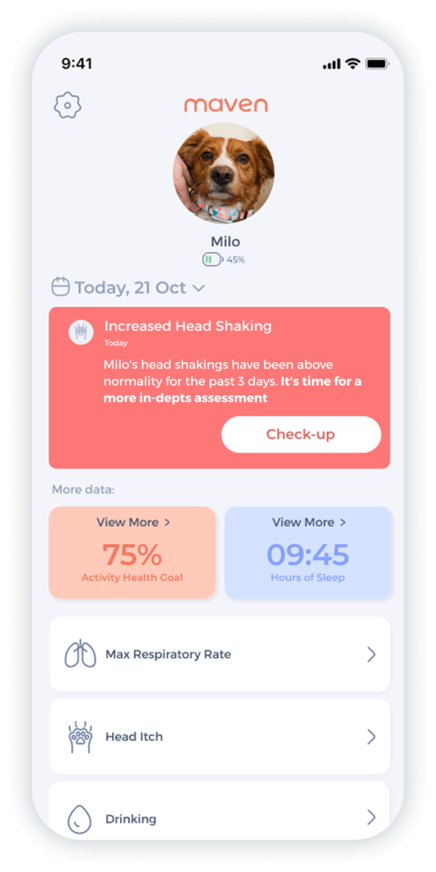
Monitor heart rate, respiratory rate, activity & rest, drinking, itch behavior.
The Maven Pet Health Monitor is designed to catch those changes. Through continuous, non-invasive tracking, Maven helps you stay ahead of potential episodes:
- Tracks activity levels continuously, detecting reductions in stamina or unusual fatigue patterns
- Monitors rest and recovery, identifying if your dog is taking longer to bounce back after exercise
- Measures heart rate trends
- Tracks resting respiratory rate, which may increase with underlying stress
- Builds a personalized health baseline for your dog, so deviations from their normal exercise tolerance are detected accurately
- Sends alerts when concerning patterns emerge — such as lethargy or a rising resting respiratory rate
FAQ (Vet-Reviewed)
Exercise-induced collapse (EIC) is a genetic neuromuscular disorder that causes muscle weakness and collapse in dogs during or after intense exercise. It results from a mutation in the DNM1 gene and is most common in Labrador Retrievers, though it affects several other breeds as well.
EIC is rarely fatal, but it can be in severe cases — particularly if exercise is not stopped at the first sign of symptoms.
Symptoms include a wobbly or staggering gait, hind limb weakness, loss of coordination, and, in severe cases, complete collapse. Most dogs remain conscious and alert during an episode. Symptoms typically peak 3 to 5 minutes after exercise stops.
Stop all activity immediately, move your dog to a cool and calm environment, ensure their airway is clear, offer water, and cool them down by wetting their coat. If recovery takes more than 30 minutes or symptoms are severe, contact your vet or an emergency clinic right away.
EIC cannot be cured, but episodes can be prevented by avoiding high-intensity and high-excitement activities, exercising in cooler conditions, and stopping activity at the earliest sign of weakness. Continuous health monitoring tools like the Maven Pet Health Monitor can help detect early warning signs before an episode occurs.
Conclusion
Exercise-induced collapse in dogs is understandably alarming but it is also a manageable condition. With the right awareness and careful activity management, most affected dogs go on to live full, joyful lives.
The most important things you can do as an owner are: know your dog’s breed risk, learn the early warning signs, and never push through the first sign of weakness during exercise. And if you want to stay one step ahead, tracking your dog’s activity, heart rate, and respiratory patterns over time gives you the kind of insight that can make a the difference.
Maven Pet focuses on improving the quality of life of our pets with technology, using artificial intelligence (AI) to enable proactive pet care. By accurately collecting and monitoring pet data 24/7 and flagging any irregularities, Maven Pet empowers pet parents and veterinarians to stay ahead of potential health issues, ensuring the well-being and longevity of our beloved companions.