Heart Issues in Cats: Early Signs to Watch (Vet Verified)

Cats are experts at hiding discomfort and heart problems are no exception. By the time most owners notice something is wrong, the disease is often already advanced. Learning to spot the subtle early signs of heart issues in cats, and knowing which cats face higher risk, can make a meaningful difference in how quickly your cat gets the help they need.
Heart Issues in Cats – The Short Answer
Heart problems in cats are common but frequently go undetected because cats rarely show obvious symptoms until disease is advanced. The most common condition is hypertrophic cardiomyopathy, which causes the heart walls to thicken. Early signs of heart issues in cats include faster breathing at rest, hiding, reduced activity and loss of appetite.
Key Takeaways
- Heart issues in cats are among the most common causes of death, with hypertrophic cardiomyopathy (HCM) being the most frequent form
- Many cats show no symptoms until heart disease is advanced – early signs are subtle and easy to miss
- Faster resting breathing, hiding, reduced activity and appetite changes are among the earliest indicators
- Certain breeds including Maine Coon and Ragdoll cats carry a higher genetic risk
- Continuous monitoring of resting respiratory rate, heart rate and activity can help detect changes before a crisis occurs
What Are Common Heart Issues in Cats?
Cardiovascular disease is among the ten most common causes of death in cats. The most common form is hypertrophic cardiomyopathy (HCM), a condition in which the walls of the heart become abnormally thickened and stiff, reducing its ability to fill efficiently with blood. HCM affects an estimated 15% of the general cat population, rising to around 29% in older cats.
Other feline heart conditions include:
- Restrictive cardiomyopathy (RCM): the heart muscle becomes rigid and cannot fill properly with blood
- Dilated cardiomyopathy (DCM): the heart walls become thin and contract weakly, reducing pumping efficiency
- Arrhythmogenic cardiomyopathy: affects the electrical conduction of the heart, causing dangerous arrhythmias
- Arterial thromboembolism (ATE): a serious complication where blood clots travel from the heart to a blood vessel, often causing sudden paralysis of the hind limbs
Conditions like hyperthyroidism and systemic hypertension can also affect the heart, causing structural changes that mimic primary cardiomyopathy and must be ruled out as part of any cardiac evaluation.
What Are the Signs of Heart Issues in Cats?
The signs in cats vary depending on the stage and type of disease. In the early stages, they can be so mild that they are easy to attribute to normal aging or stress.
Subtle early signs to watch for:
- Increased resting respiratory rate: breathing faster than 30 breaths per minute while asleep or resting is one of the most important early indicators of heart trouble
- Hiding more than usual: cats in discomfort instinctively seek out quiet, isolated spots
- Reduced activity or playfulness: tiring more easily or showing less interest in daily routines
- Decreased appetite: eating less or showing reduced interest in food
- Open-mouth breathing after mild exertion: might mean that the heart is struggling under normal demands
Signs of more advanced heart disease:
- Labored or rapid breathing, even at rest
- Sudden hind limb weakness or paralysis – a sign of ATE that is a veterinary emergency
- Fainting or collapse
- Abdominal swelling from fluid accumulation
- Pale or bluish gums
“Cats often mask signs of disease, including the ones related to heart problems, until the disease becomes more advanced. Subtle changes like increased resting respiratory rate or reduced activity can be the earliest clues, making ongoing monitoring especially valuable.” – Joana Babo, DVM, Veterinarian at Maven Pet
Why Are Heart Problems Hard to Detect in Cats?
Feline heart problems are notoriously difficult to catch early for several reasons. Cats with heart disease are less likely than dogs to have a detectable heart murmur, which means one of the most common diagnostic triggers in other animals is often absent. Many cats with even significant heart disease have completely normal auscultation findings.
Cats are also physiologically adept at compensating. They reduce their activity, rest more and avoid exertion. All of these are adjustments that delay the appearance of obvious symptoms. Because cats spend much of their day resting, owners often don’t notice gradual declines in energy or subtle changes in breathing until the disease has progressed considerably.
Routine veterinary visits alone are frequently insufficient for early detection: a cat can appear perfectly normal during a physical exam while carrying significant underlying cardiac disease. This is why tracking measurable indicators, particularly resting respiratory rate and activity trends over time, is so valuable.
Which Cats Are More at Risk?
While heart problems can affect any breed, sex or age, certain factors increase the likelihood:
- Breed: Maine Coon and Ragdoll cats carry known genetic mutations (in the MYBPC3 gene) that significantly increase their risk of HCM. Other breeds at elevated risk include British Shorthair, Sphynx, Persian, Bengal, Norwegian Forest cat and Birman
- Age: HCM prevalence increases with age, affecting up to 29% of older cats
- Sex: male cats are more likely to develop HCM than females
- Genetics: first-degree relatives of cats diagnosed with HCM face higher risk, regardless of breed
- Comorbidities: hyperthyroidism and systemic hypertension can both cause or worsen cardiac changes
Genetic testing is recommended for Maine Coon and Ragdoll cats intended for breeding, and regular echocardiographic screening should be considered even in cats that test negative for known mutations, as other genetic factors may still be at play.
“Every time Umi is hospitalized, it’s for like four days and it costs over $5,000… Maven has helped me not only save money but also save his life”
★★★★★
Jessica Ortiz
Umi
When Should You Contact a Veterinarian?
Contact your veterinarian promptly if you notice any of the following in your cat:
- A resting respiratory rate consistently above 30 breaths per minute
- Labored, rapid or open-mouth breathing at any time
- Sudden inability to use one or more legs
- Fainting, collapsing or seizure-like episodes
- Persistent hiding, appetite loss or unusual lethargy
- A heart murmur or abnormal rhythm detected incidentally during a routine visit
For cats in high-risk breeds, or those over 7–8 years of age, proactive cardiac evaluation, including echocardiography, should be discussed with your vet even in the absence of symptoms. Echocardiography is the gold standard for diagnosing feline cardiomyopathy and is the most accurate tool for assessing prognosis.
How Maven Pet Helps
Because heart issues in cats so often develop silently, continuous monitoring is one of the most practical tools available to owners today. The Maven pet health tracker monitors your cat around the clock, building a personalized baseline and alerting you when something shifts, and likely before symptoms become obvious.

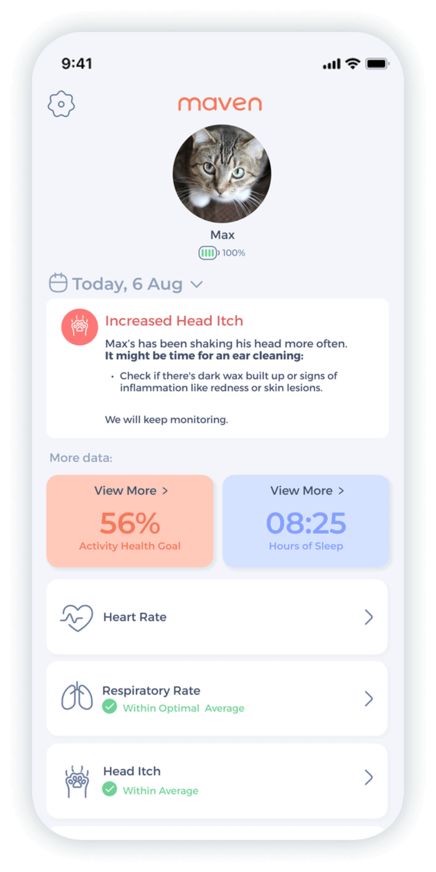
Monitor heart rate, respiratory rate, activity & rest, itch behavior.
The Maven pet health app, combined with a cat health tracker, enables continuous tracking of:
- Cat respiratory rate tracker: resting respiratory rate is one of the earliest measurable signs of cardiac stress. A rising rate at rest is a key warning signal
- Cat heart rate tracker: detects trends that may indicate underlying cardiac strain before clinical signs appear
- Activity levels: identifies unexplained reductions in movement or engagement throughout the day
- Rest patterns: flags increases in sleep or disrupted recovery cycles
Unlike a single vet visit snapshot, Maven builds a continuous picture of your cat’s normal, allowing even gradual, subtle changes to be captured and flagged early.
FAQ (Vet-Reviewed)
They range from subtle signs like faster resting breathing above 30 breaths per minute, hiding, reduced appetite, lower activity, to severe ones, including labored or open-mouth breathing, sudden hind limb paralysis, fainting and abdominal swelling. In many cats, no symptoms are visible until the disease is advanced.
Yes. This is one of the most challenging aspects of feline heart problems. Cats instinctively reduce their activity and rest more when they feel unwell, which masks symptoms effectively. Many cats with significant heart disease appear completely normal to their owners and even during a routine veterinary examination.
Diagnosis typically involves physical examination, chest X-rays, ECG, blood pressure measurement, cardiac biomarker tests such as NT-proBNP and echocardiography, which is the gold standard test. Blood tests including thyroid levels are also recommended to rule out secondary causes such as hyperthyroidism.
A resting respiratory rate above 30 breaths per minute warrants veterinary attention. Any labored breathing, open-mouth breathing or breathing difficulty is a potential emergency, particularly if accompanied by lethargy, pale gums or sudden weakness. When in doubt, contact your veterinarian.
Conclusion
Heart issues in cats are more common than many owners realize – and more silent. The earliest signs are easy to dismiss, and by the time a crisis occurs, significant disease is often already present. Knowing what to look for, which cats face higher risk, and how to track measurable indicators like resting respiratory rate and activity over time gives you and your veterinarian the best possible chance of catching heart problems early.
Maven Pet focuses on improving the quality of life of our pets with technology, using artificial intelligence (AI) to enable proactive pet care. By accurately collecting and monitoring pet data 24/7 and flagging any irregularities, Maven Pet empowers pet parents and veterinarians to stay ahead of potential health issues, ensuring the well-being and longevity of our beloved companions.