Dog Dementia: Can Dogs Get Dementia? (Vet Verified)

If your senior dog has started acting a little “off” – staring at walls, pacing at night, or seeming confused in rooms they’ve known for years – you may be wondering whether dogs can develop something like dementia. The good news is that these changes have a name, a reasonably well-understood cause, and ways to evaluate them.
Can Dogs Get Dementia? – The Short Answer
Yes, dogs can get dementia. It’s known medically as canine cognitive dysfunction (CCD), an age-related brain condition similar to Alzheimer’s disease in humans. Dementia typically develops gradually in senior dogs, most often starting around 9 years of age, and can cause disorientation, changed sleep patterns, house-soiling, and altered social behavior. A veterinarian can help distinguish it from normal aging.
Key Takeaways
- Dogs can develop canine cognitive dysfunction (CCD), commonly called dog dementia
- CCD shares features with human Alzheimer’s disease, including a buildup of beta-amyloid protein in the brain
- Signs are often grouped under the acronym DISHAA: disorientation, interaction changes, sleep disruption, house-soiling, activity changes and anxiety
- CCD is frequently underdiagnosed because early signs are subtle and easy to mistake for normal aging
- A veterinary evaluation is the only way to tell CCD apart from normal aging or another medical issue
What Is Dog Dementia?

Dog dementia, or canine cognitive dysfunction (CCD), is a common age-related disease that affects the brain, causing deterioration similar to Alzheimer’s disease in humans. It’s caused by gradual brain changes, most notably a buildup of the toxic protein beta-amyloid, which interferes with normal neuron function.
The condition typically doesn’t appear overnight. Dogs may start to develop CCD around nine years of age or older, and because changes progress slowly, they’re often mistaken for ordinary aging.
Can Dogs Get Dementia?
Yes, and it’s more common than many owners realize. CCD is estimated to affect 8.1% of dogs aged 8 to 11 years, climbing to 18.8% in dogs 11 to 13, 45.3% in dogs 13 to 15, and 67.3% in dogs 15 to 17. Research from the Dog Aging Project found that the odds of a dog having CCD increased by 52% with each additional year of age.
Despite this, most cases go unreported. In one survey, CCD was estimated in 14.2% of dogs, but only 1.9% of cases were brought to a veterinarian’s attention.
“I got the Maven sensor for my 14-year-old Chihuahua mix with heart and trachea issues. It gave me back peace of mind – I can track her RRR, BPM, drinking, and activity anytime and know instantly if something’s wrong. Highly recommend!”

★★★★★
Chiara De Luca
Titti
What Is Canine Cognitive Dysfunction?
CCD is formally defined as behavioral signs indicating a gradual decline in cognitive function that cannot be attributed to other medical, neurological, or behavioral conditions. It’s a diagnosis of exclusion, which means other causes must be ruled out first.
Veterinary professionals organize CCD signs using the acronym DISHAA, recommended by the Canine Cognitive Dysfunction Syndrome Working Group: disorientation, impaired social interactions, sleep disturbances, house soiling (with learning/memory deficits), activity changes, and anxiety.
How Is Dementia in Dogs Different From Normal Aging?
It’s normal for senior dogs to slow down. CCD is different because it involves a specific pattern of decline tied to brain changes, not just general slowing. The distinction matters: dogs with a history of neurological, eye, or ear disorders had higher odds of CCD, and conditions like arthritis or sensory loss can look similar on the surface.
This overlap is part of why CCD is often underdiagnosed, despite affecting between 14% and over 60% of dogs over eight years old depending on the study. A veterinary evaluation is what separates normal aging from a distinct, treatable condition.
What Changes Can Dog Dementia Cause?

- Disorientation: getting lost in familiar places or staring blankly at walls
- Interaction changes: becoming clingy or withdrawn, or not recognizing familiar people
- Sleep pattern changes: wandering at night and sleeping more during the day
- House-soiling: accidents indoors despite prior house-training
- Activity changes: decreased play interest, restlessness, or pacing
- Anxiety: new phobias, irritability, or general unease
- Learning changes: no longer responding to familiar commands
These signs can appear as one clinical sign that progresses, or several at once, with severity ranging from subtle to disruptive.
When Should You Talk to a Veterinarian?
Schedule a visit if your dog shows any combination of:
- Confusion in familiar spaces
- Nighttime restlessness or vocalizing
- Indoor accidents from a house-trained dog
- Shifts in how they interact with you or other pets
- New anxiety around things that didn’t bother them before
Don’t assume it’s “just age”. A veterinary evaluation is the only reliable way to know what’s going on.
How Veterinarians Evaluate Cognitive Changes
There’s no single definitive test. Instead, your vet will perform a physical exam and recommend blood and urine tests to rule out conditions with similar signs, such as pain, arthritis, seizure disorders, and vision or hearing loss. An MRI may rule out structural issues.
New guidelines also propose a three-tiered severity scale – mild, moderate, severe – based on how much changes interfere with daily life, useful for both diagnosis and tracking.
How Maven Pet Helps Monitor Senior Dog Health
Maven doesn’t diagnose dog dementia or measure cognitive function directly – that requires a veterinary evaluation. What it offers is a clearer, ongoing picture of your dog’s daily patterns.
The pet health tracker monitors activity, rest, heart rate, resting respiratory rate, scratching, and water intake, building a personalized baseline and sending alerts when patterns shift – including activity via the dog activity tracker and sleep via the dog sleep tracker, two behaviors closely tied to cognitive decline.
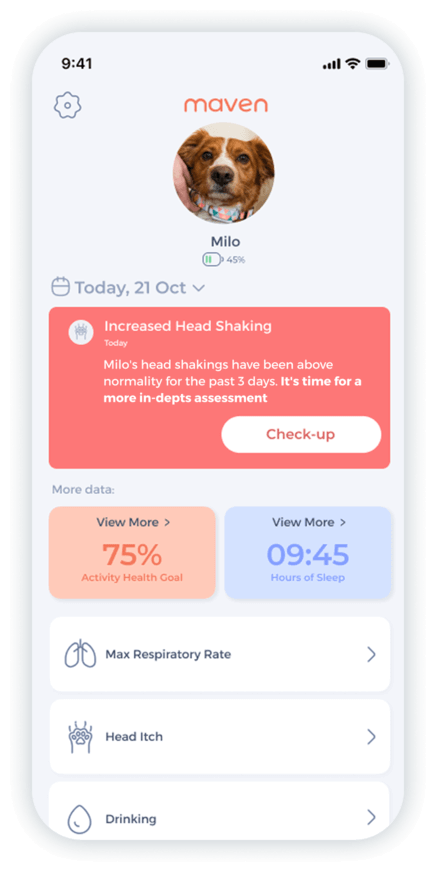
Monitor heart rate, respiratory rate, activity & rest, drinking, itch behavior.
“Cognitive changes can develop gradually, so owners may not recognize how much a dog’s behavior has changed until they compare it with their previous routine. Tracking patterns over time can help identify meaningful changes and give your veterinarian useful context.” – Joana Babo, DVM, Veterinarian at Maven Pet
The pet health app brings this data together, and the dog health tracker covers the full range of metrics.
FAQ (Vet-Reviewed)
Yes. Dogs can develop canine cognitive dysfunction (CCD), often compared to Alzheimer’s disease in humans.
The clinical term is canine cognitive dysfunction (CCD), commonly called “dog dementia.”
Mild disorientation, subtle sleep changes, or reduced interest in play. These are easy to miss at first.
No. It becomes more common with age but is a distinct medical condition, not inevitable.
As soon as you notice new or worsening changes like disorientation, house-soiling, or altered sleep.
Conclusion
Dog dementia is real, medically recognized, and more common than many expect – but not inevitable. Because its signs overlap with normal aging and other conditions, the most useful thing you can do is pay attention to patterns and loop in your vet early rather than assuming it’s “just age.”
Maven Pet focuses on improving the quality of life of our pets with technology, using artificial intelligence (AI) to enable proactive pet care. By accurately collecting and monitoring pet data 24/7 and flagging any irregularities, Maven Pet empowers pet parents and veterinarians to stay ahead of potential health issues, ensuring the well-being and longevity of our beloved companions.