Dog Dementia Signs: 7 Symptoms Owners Should Watch (Vet Verified)

Noticing something different about your senior dog – a blank stare, a nighttime accident, confusion in the backyard they’ve known for years – can be unsettling. These changes don’t automatically mean dementia, but they’re worth watching. Knowing the most recognizable signs of canine cognitive dysfunction (CCD) can help you tell ordinary aging apart from something worth a closer look.
What are the signs of dog dementia? – The Short Answer
Dog dementia signs typically fall into seven categories: disorientation, changes in interaction with people or pets, disrupted sleep-wake cycles, house-training accidents, altered activity or repetitive behaviors, increased anxiety or vocalization, and difficulty with familiar routines. These changes usually develop gradually in senior dogs and often appear together rather than as a single isolated symptom.
Key Takeaways
- Dog dementia signs are commonly grouped into seven categories, often remembered by the acronym DISHAA
- Early signs can be subtle and easy to mistake for normal aging
- Signs often overlap and appear in combination, not just as one isolated change
- Other medical conditions can cause similar-looking symptoms
- A pattern of changes over time matters more than a single unusual moment
7 Dog Dementia Signs Owners Should Watch

1. Disorientation or Getting Lost in Familiar Places
Affected dogs may get lost in familiar places, get stuck behind furniture, or stare blankly at walls or into space. Some also go to the hinge side of a door instead of the opening.
2. Changes in Interaction With People or Pets
This might mean becoming suddenly clingy or avoidant, or not recognizing familiar people. Some dogs become more irritable, fearful, or aggressive with visitors or other animals, or show less interest in affection.
3. Changes in the Sleep-Wake Cycle
Dogs may start wandering at night and sleeping more during the day, often with pacing, restlessness, or vocalization at night – usually one of the first signs owners notice.
4. House-Training Accidents
This shows up as urinating or defecating indoors despite prior house-training, along with decreased signaling to go outside and difficulty learning new tasks.
5. Changes in Activity or Repetitive Behaviors
Some dogs show decreased interest in playing or other activities, while others develop repetitive pacing, wandering, circling, or licking. Lower activity levels have also been linked to higher CCD likelihood.
6. Increased Anxiety, Restlessness or Vocalization
This can appear as new phobias, irritability, or heightened generalized anxiety, including anxiety when separated from owners, fear of new environments, or reactivity to sounds and sights that never used to bother them.
7. Difficulty With Familiar Routines or Tasks
This includes no longer responding to known commands or struggling to learn new ones, plus difficulty navigating stairs, trouble finding dropped food, and squeezing through narrow spaces.
What Are the First Signs of Dementia in Dogs?
Early signs are often subtle. In one survey, the four most frequently reported early problems were apparent confusion, anxiety, sleep-wake disturbance, and altered interaction with the owner – part of why the original DISH acronym expanded to DISHA and then DISHAA. Early on, these changes may come and go or seem mild enough to chalk up to a bad day.
“I got the Maven sensor for my 14-year-old Chihuahua mix with heart and trachea issues. It gave me back peace of mind – I can track her RRR, BPM, drinking, and activity anytime and know instantly if something’s wrong. Highly recommend!”

★★★★★
Chiara De Luca
Titti
How Do I Know If My Dog Has Dementia?
You can’t diagnose it at home, but tracking what you observe gives your vet a clearer starting point. Note which of the seven categories apply and how often. A recently published severity grading scale classifies CCD as mild, moderate or severe based on how much changes interfere with daily function. Your vet will use a similar approach alongside a physical exam and testing.
When Symptoms Need a Veterinary Evaluation
See your vet if you notice any of the seven signs, especially if new or worsening. CCD is a diagnosis of exclusion. Dogs with a history of neurological, eye, or ear disorders had significantly higher odds of a CCD diagnosis, and pain, vision loss, hearing loss, and metabolic conditions can all cause look-alike symptoms. Only a veterinary workup can sort out which explanation fits.
How Maven Pet Helps Monitor Changes Over Time
Maven can’t detect confusion or memory loss, and it can’t diagnose cognitive dysfunction directly – that requires a veterinary evaluation. It can track physical patterns that often accompany cognitive changes.
The pet health tracker builds a personalized baseline across activity, rest, heart rate, resting respiratory rate, scratching and water intake. Reduced activity via the dog activity tracker and disrupted rest via the dog sleep tracker are two behaviors closely tied to cognitive decline.
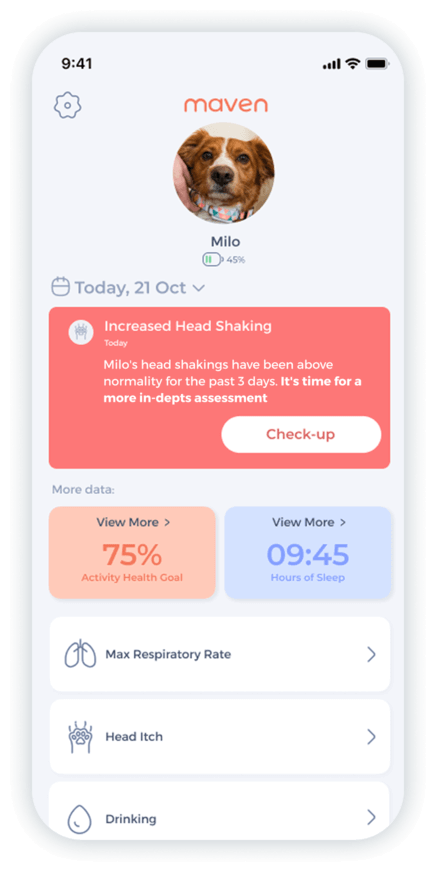
Monitor heart rate, respiratory rate, activity & rest, drinking, itch behavior.
“The first signs of cognitive decline can be subtle and may come and go. Looking at changes as a pattern, rather than focusing on one unusual behavior, can help owners recognize when something has genuinely changed and provide better information to their veterinarian.” – Joana Babo, DVM, Veterinarian at Maven Pet
The pet health app brings this together, and the dog health tracker covers the full set of metrics.
FAQ (Vet-Reviewed)
Mild confusion, anxiety, disrupted sleep, and subtle changes in owner interaction. These can be easy to miss at first.
You can’t diagnose it at home, but tracking behavior changes gives your vet useful information for evaluation.
Disorientation, altered interactions, sleep-wake disruption, house-soiling, activity changes, anxiety, and difficulty with routines.
Yes, especially aimless pacing or wandering at night.
Yes. Pain, vision or hearing loss, and other conditions can resemble cognitive dysfunction, so a veterinary workup is necessary.
Conclusion
Dog dementia rarely announces itself with one dramatic symptom – it shows up gradually, across several categories, often in combination. Paying attention to the pattern, rather than dismissing individual moments, helps you catch meaningful changes early and start a conversation with your vet about what’s really going on.
Maven Pet focuses on improving the quality of life of our pets with technology, using artificial intelligence (AI) to enable proactive pet care. By accurately collecting and monitoring pet data 24/7 and flagging any irregularities, Maven Pet empowers pet parents and veterinarians to stay ahead of potential health issues, ensuring the well-being and longevity of our beloved companions.