Symptoms of Heart Disease in Cats: Early Signs (Vet Verified)

You know your cat. You know how they sleep, how much they move, how quickly they finish their food. So when something feels slightly off — a little less activity, breathing that seems faster than usual — it’s natural to wonder whether it means something.
With heart disease, that instinct is worth following. The symptoms of heart disease in cats are often subtle in the early stages, and the window between “something seems different” and a more serious event can be narrow.
What Are the Symptoms of Heart Disease in Cats?
Symptoms of heart disease in cats include increased resting respiratory rate, labored breathing, reduced activity, lethargy, appetite loss, and weight loss. In advanced cases, open-mouth breathing, hind limb weakness, or sudden collapse may occur.
Key Takeaways
- Early symptoms of heart disease in cats are often subtle — reduced activity and faster breathing at rest are among the first signs
- Many cats show no symptoms at all until the disease is well advanced
- Emergency symptoms including open-mouth breathing and hind limb paralysis require immediate veterinary attention
- Continuous monitoring enables earlier recognition of symptom patterns before they become severe
Symptoms of Heart Disease in Cats, Explained
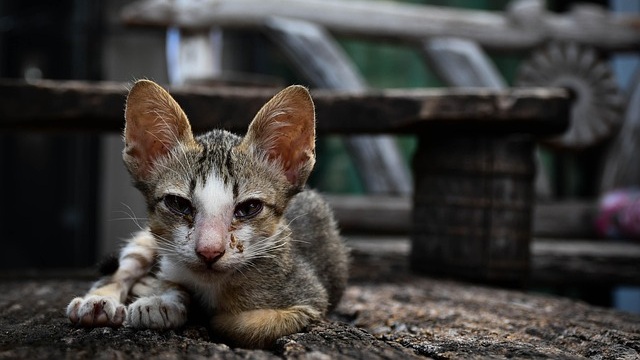
Symptoms of heart disease in cats span a wide spectrum — from barely noticeable changes in daily behavior to life-threatening emergencies. According to the Cummings School of Veterinary Medicine at Tufts University, cats usually do not show outward symptoms until heart disease is already advanced, and are less likely than dogs to present with a detectable heart murmur — which can further delay diagnosis.
When symptoms do appear, they commonly include:
- Labored or rapid breathing — visible effort with each breath, or noticeably faster breathing without exertion
- Increased resting respiratory rate — more than 30 breaths per minute during sleep or calm rest
- Reduced activity — less interest in play, reluctance to jump, or general low energy
- Increased sleeping or hiding — seeking isolation or resting far more than usual
- Reduced appetite — eating less or showing less interest in food
- Unexplained weight loss
- Weak or altered pulses
- Pale or bluish gums — a sign of inadequate circulation
It is also worth noting that coughing, which is a common sign of heart disease in dogs, is not typical in cats. If your cat coughs frequently, this more likely indicates a respiratory condition such as asthma or bronchitis rather than cardiac disease.
What Are the Early Signs Owners Often Miss?
The earliest symptoms of heart disease in cats tend to be the easiest to overlook — partly because they develop gradually, and partly because they resemble what many owners attribute to aging or a quiet personality.
A subtle increase in breathing rate at rest is one of the most clinically significant early indicators. A healthy cat typically takes 15 to 30 breaths per minute during sleep. A resting respiratory rate that consistently sits above 30 — even if the cat appears otherwise normal — warrants veterinary assessment. The challenge is that this change is nearly invisible without systematic monitoring; it’s not something most owners would notice in passing.
Reduced activity is another early sign that is frequently missed. Cats are not known for constant activity, which makes a gradual decline in movement easy to normalize. A cat that used to greet you at the door, climb to their favourite perch, or engage in short bursts of play — but no longer does — may be conserving energy due to a heart that isn’t pumping efficiently.
Changes in sleep patterns are similarly subtle. A cat sleeping more than usual, or in unusual locations (often lower to the ground or more isolated), may be responding to fatigue or mild respiratory discomfort.
Mild appetite changes — eating a little less, taking longer at the bowl, or being less enthusiastic about food — can precede more obvious signs by weeks.
None of these signs is definitive on its own. Their significance lies in the pattern: a gradual, sustained shift from a cat’s established normal.
“In cats, symptoms of heart disease often appear late and can be subtle at first. Changes like increased resting respiratory rate or decreased activity are important early warning signs that shouldn’t be ignored.” — Sara Leitão, DVM, Veterinarian at Maven Pet
What Are Emergency Symptoms to Watch For?
Some symptoms of heart disease in cats indicate a critical situation requiring immediate emergency veterinary care. Do not wait for a scheduled appointment if your cat shows any of the following:
- Open-mouth breathing at rest — any open-mouth breathing in a cat that is not overheated or under acute stress is always abnormal and constitutes a veterinary emergency
- Labored breathing with visible chest or abdominal effort — may indicate fluid accumulation in or around the lungs (pleural effusion or pulmonary edema)
- Sudden hind limb weakness, pain, or paralysis — a hallmark sign of aortic thromboembolism (ATE), a life-threatening complication in which a blood clot obstructs blood flow to the hind legs.
- Blue, grey, or white gums — indicates severe oxygen deprivation
- Sudden collapse or loss of consciousness
- Extreme restlessness combined with difficulty breathing — the cat cannot find a comfortable position
These signs require emergency care without delay. In cases of ATE, prompt treatment significantly affects the outcome.
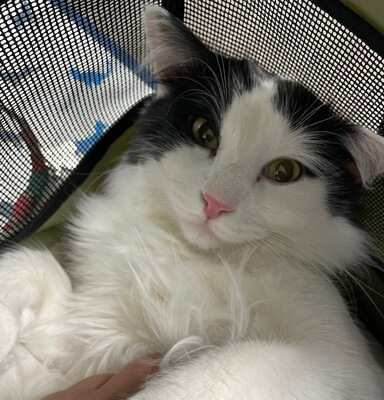
“Every time Umi is hospitalized, it’s for like four days and it costs over $5,000… Maven has helped me not only save money but also save his life”
★★★★★
Jessica Ortiz
Umi
Why Do Symptoms Appear Late in Cats?
There are two reasons why heart disease symptoms in cats tend to emerge late: one is biological, and one is behavioral.
Biologically, the feline heart has a remarkable ability to compensate for structural changes over time. As the heart muscle thickens or stiffens, the body adapts — adjusting heart rate, blood pressure, and fluid balance to maintain function. This compensation can continue for months or years before it breaks down. By the time symptoms become visible, the disease has typically been progressing silently for some time.
Behaviorally, cats are instinctive concealers of weakness. This trait, rooted in their evolutionary history as both predator and prey, means they reduce activity and withdraw rather than showing overt distress. A cat that is struggling will often appear simply quieter or less engaged — not sick.
Together, these factors mean that owners and even veterinarians can miss early-stage heart disease during a routine exam.
How Can You Monitor Symptoms at Home?
Because early symptoms are subtle and gradual, the most effective monitoring strategy is systematic and consistent observation — rather than relying on individual moments.
Track resting respiratory rate regularly. Either manually or automatically using a validated tool.
Note changes in daily behavior patterns. Is your cat moving less? Sleeping more? Engaging less with their environment? Small, consistent changes matter more than single observations.
Monitor appetite and body condition. Weight loss in cats can be gradual and hard to detect by eye. Regular weigh-ins at home or at the vet help catch this early.
How Maven Helps
The challenge with monitoring symptoms of heart disease in cats at home is that the most important changes are the ones that happen too gradually to notice in real time. This is where continuous, automated tracking provides something human observation alone cannot.

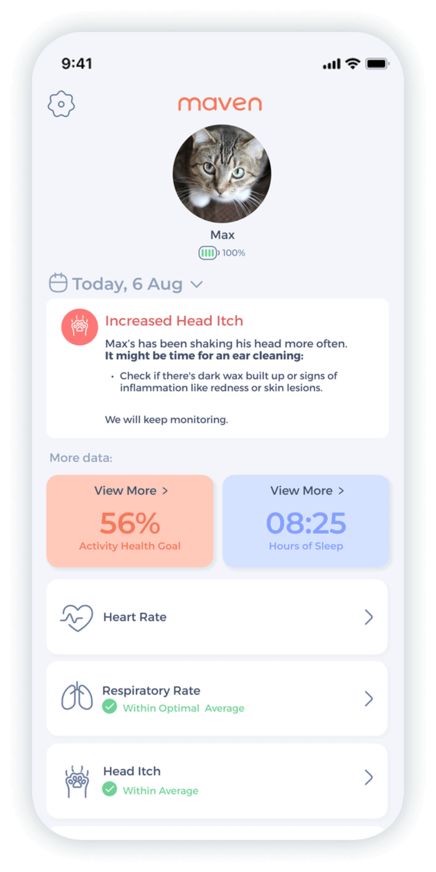
Monitor heart rate, respiratory rate, activity & rest, itch behavior.
The Maven Pet Health Monitor is designed to capture exactly the kind of subtle, sustained shifts that precede more serious symptoms:
- Tracks resting respiratory rate continuously, helping detect early breathing changes before they become visible to the naked eye
- Monitors activity levels, identifying reductions in daily movement or increasing lethargy over time
- Measures heart rate trends
- Tracks rest patterns, detecting an increase in sleep duration or changes in resting behavior that may reflect fatigue
- Builds a personalized baseline for each individual cat, so deviations are flagged against what is genuinely normal for them
- Sends alerts when deviations occur, such as a rising resting respiratory rate or a notable decline in activity
FAQ (Vet-Reviewed)
Symptoms include increased resting respiratory rate, labored or rapid breathing, reduced activity, lethargy, appetite loss, weight loss, and hiding. In more advanced or acute cases, open-mouth breathing, hind limb weakness, pale or blue gums, and collapse may occur.
The earliest signs are often a subtle increase in resting respiratory rate (above 30 breaths per minute during sleep), reduced activity or willingness to play and jump, changes in sleeping patterns, and mild appetite changes. These signs develop gradually and are easy to attribute to aging or personality — which is why tracking trends over time matters more than any single observation.
Open-mouth breathing at rest, sudden hind limb weakness or paralysis, labored breathing with visible chest effort, blue or pale gums, and collapse all require immediate emergency veterinary care. These symptoms can indicate congestive heart failure or aortic thromboembolism, both of which are life-threatening without prompt treatment.
Cats instinctively conceal signs of weakness, a survival behavior rooted in their evolutionary history. Combined with the heart’s biological ability to compensate for structural changes over time, this means heart disease often progresses silently for months before obvious symptoms emerge. By the time a cat appears visibly unwell, the disease is frequently already at an advanced stage.
Conclusion
The symptoms of heart disease in cats are not always dramatic. More often, they are quiet — a slightly faster breath during sleep, a little less movement across the day, a food bowl that empties more slowly. These are the signs that matter most, precisely because they are the ones most easily missed.
Catching heart disease early in cats requires more than waiting for something obvious. It requires knowing your cat’s normal well enough to notice when it changes — and having a way to track those changes consistently, before a subtle shift becomes a crisis.
Maven Pet focuses on improving the quality of life of our pets with technology, using artificial intelligence (AI) to enable proactive pet care. By accurately collecting and monitoring pet data 24/7 and flagging any irregularities, Maven Pet empowers pet parents and veterinarians to stay ahead of potential health issues, ensuring the well-being and longevity of our beloved companions.