Sinus Arrhythmia in Dogs

Your vet mentioned something about an arrhythmia during your dog’s appointment, and your heart sank. The word alone sounds serious. But if what they detected is sinus arrhythmia, there’s nothing to worry about.
Sinus arrhythmia is one of the most common cardiac findings in dogs, and in most cases, it’s a completely normal part of how a healthy dog’s heart works. Here’s what it means, when it matters, and how to stay on top of your dog’s heart health going forward.
What Is Sinus Arrhythmia in Dogs?
Sinus arrhythmia in dogs is an irregular heart rhythm that originates in the sinus node — the heart’s natural pacemaker. Rather than beating at a steady rate, the heart speeds up and slows down in a normal and cyclical pattern.
Unlike other types of arrhythmias, sinus arrhythmia does not involve abnormal electrical impulses in the heart. The heart’s pacing mechanism is working correctly. It’s simply responding to normal physiological signals, most commonly the breathing cycle.
Answer-First Block
Sinus arrhythmia in dogs is a common and usually normal variation in heart rhythm, where the heart rate rises and falls in sync with the dog’s inhale and exhale pattern. It is a well-recognized physiological finding in healthy dogs and is rarely a cause for concern. However, when arrhythmia occurs alongside other symptoms or changes, veterinary evaluation is recommended.
Key Takeaways
- Sinus arrhythmia is considered a normal cardiac finding in dogs by veterinary cardiologists
- It is most commonly linked to the breathing cycle and reflects healthy vagal tone
- Sinus arrhythmia disappears with excitement or exercise — in healthy dogs, this is expected
- It can be detected by auscultation and in an electrocardiogram (ECG)
What Is Sinus Arrhythmia in Dogs?
The heart’s rhythm is controlled by the sinus node, a small cluster of cells in the right atrium that fires electrical signals to coordinate each heartbeat. In sinus arrhythmia, the firing rate fluctuates — the heart beats faster at certain moments and slower at others, creating an irregular rhythm.
“Sinus arrhythmia is a normal finding in healthy dogs and is linked to breathing. The key is we can’t assess heart rhythm from home, but we can track resting heart rate and respiratory rate — and sustained changes in either can be an early signal that something is worth investigating.” — Sara Leitão, DVM, Veterinarian at Maven Pet
“I got the Maven sensor for my 14-year-old Chihuahua mix with heart and trachea issues. It gave me back peace of mind – I can track her RRR, BPM, drinking, and activity anytime and know instantly if something’s wrong. Highly recommend!”

★★★★★
Chiara De Luca
Titti
What Is Respiratory Sinus Arrhythmia in Dogs?
Respiratory sinus arrhythmia (RSA) is the most common form of sinus arrhythmia in dogs, and it follows a predictable pattern tied directly to breathing. When the dog inhales, the heart rate increases slightly. When the dog exhales, the heart rate slows. This cyclical fluctuation repeats with every breath.
This is a well-established physiological response. Research has shown that RSA in dogs can be quite pronounced — the variation between inspiratory and expiratory heart rate can represent a substantial portion of overall heart rate variability. It reflects the normal interplay between the respiratory and cardiovascular systems via the vagus nerve. Importantly, respiratory sinus arrhythmia tends to disappear with exercise and excitement. In a healthy dog, this is exactly what is expected.
Is Sinus Arrhythmia Normal in Dogs?
Yes, in the vast majority of cases, sinus arrhythmia is a completely normal finding in dogs. Leading veterinary references, including the Merck Veterinary Manual, classify sinus arrhythmia as a normal rhythm in dogs, contrasting it with the same finding in cats, where it may indicate an underlying issue.
Brachycephalic breeds — such as Bulldogs, Pugs, and French Bulldogs — may show more pronounced sinus arrhythmia due to their increased breathing effort, which amplifies vagal activity. This is typically not a clinical concern in itself, though these breeds do warrant monitoring for related respiratory issues.
The bottom line: if your vet heard an irregular rhythm in your relaxed dog and identified it as sinus arrhythmia, this is most often a reassuring finding, not an alarming one.
When Could Sinus Arrhythmia Be a Concern?
While sinus arrhythmia is usually benign, there are situations where it warrants closer attention:
- It is very pronounced or causes long pauses between heartbeats — extreme sinus arrhythmia can sometimes overlap with conditions like sinus arrest, which may cause fainting or weakness
- It is accompanied by symptoms such as fainting (syncope), weakness, exercise intolerance, or difficulty breathing
- Underlying cardiac disease is suspected — in dogs with known heart conditions such as myxomatous mitral valve disease (MMVD), a loss of respiratory sinus arrhythmia has been identified as a negative prognostic indicator
If any of these apply, your vet may recommend further workup, including an ECG, echocardiogram, or extended heart rate monitoring.
How Do Vets Diagnose Sinus Arrhythmia?
The primary tools for diagnosing sinus arrhythmia are auscultation with a stethoscope and an electrocardiogram (ECG or EKG), which records the heart’s electrical activity and captures the pattern of rhythm changes. In some cases, additional tests may be recommended to rule out other causes:
- Holter monitor — a wearable device that records heart rhythm continuously over 24 hours, useful for capturing intermittent changes during daily activity
- Echocardiogram — if structural heart disease is suspected
- Blood work and chest X-rays — to evaluate overall health and rule out respiratory or systemic causes
How Can You Monitor Your Dog’s Heart Health?
For most dogs with sinus arrhythmia, no treatment is needed — only monitoring. The goal is to establish what is normal for your individual dog and be able to detect meaningful changes early.
There are practical steps you can take at home:
- Track your dog’s resting respiratory rate (RRR) — count breaths per minute while your dog is sleeping. In healthy dogs, this is typically 15–30 breaths per minute. A sustained increase may signal cardiac or respiratory changes
- Note any new symptoms — fainting, sudden weakness, unusual fatigue, or changes in breathing during rest
- Keep a record of any episodes — if your dog shows unusual signs, note the timing, duration, and what preceded it
- Attend regular veterinary check-ups — especially for breeds predisposed to heart disease, such as Cavalier King Charles Spaniels, Boxers, and Dobermanns
How Maven Helps
The Maven Pet Health Monitor is designed to help owners and vets have an extra tool to detect early signs of concern:
- Tracks resting heart rate
- Monitors resting respiratory rate,
- Measures activity and rest patterns
- Builds a personalized baseline
- Sends alerts when deviations occur, such as a sustained increase in resting respiratory rate or abnormal heart rate measurements outside your dog’s established range

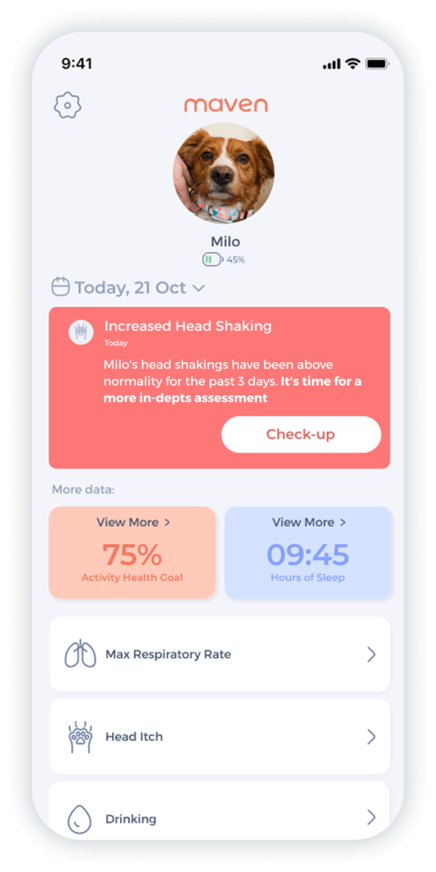
Monitor heart rate, respiratory rate, activity & rest, drinking, itch behavior.
FAQ (Vet-Reviewed)
What is sinus arrhythmia in dogs? Sinus arrhythmia is an irregular heart rhythm that originates in the sinus node — the heart’s natural pacemaker. It is considered a normal finding in dogs and is most often linked to breathing and vagal tone.
What is respiratory sinus arrhythmia in dogs? Respiratory sinus arrhythmia is the most common form of sinus arrhythmia in dogs. The heart rate increases slightly during inhalation and decreases during exhalation, following the rhythm of each breath. This is a well-recognized normal physiological response in healthy dogs.
Is sinus arrhythmia normal in dogs? Yes, in most cases. Veterinary cardiologists consider sinus arrhythmia a normal cardiac finding in dogs. It reflects healthy vagal tone and typically disappears with excitement or exercise, which is the expected response in a healthy dog.
When should I worry about sinus arrhythmia in my dog? In most cases, sinus arrhythmia is something to be aware of, not worried about. If you do notice fainting, weakness, difficulty exercising, or changes in your dog’s breathing, those are signs your vet will want to know about.
Conclusion
Hearing the word “arrhythmia” from your vet can feel alarming — but when it comes to sinus arrhythmia in dogs, the word is more often reassuring than worrying. In healthy dogs, it’s a normal reflection of how the heart and breathing system interact, and a sign of good vagal tone rather than a problem.
That said, “normal” is always relative to your individual dog. Knowing your dog’s baseline is what makes it possible to detect when something genuinely shifts. And that kind of early awareness is often what makes the difference between catching a problem early and missing it entirely.
This article has been reviewed by Saara Leitão, DVM, Veterinarian at Maven Pet. It is intended for informational purposes only and does not replace professional veterinary advice. If you have concerns about your dog’s heart rhythm or health, please consult your veterinarian.
Maven Pet focuses on improving the quality of life of our pets with technology, using artificial intelligence (AI) to enable proactive pet care. By accurately collecting and monitoring pet data 24/7 and flagging any irregularities, Maven Pet empowers pet parents and veterinarians to stay ahead of potential health issues, ensuring the well-being and longevity of our beloved companions.