
Heart Murmur in Puppies: Early Signs & What Owners Should Know (Vet Verified)

A heart murmur in puppies presents itself as an abnormal extra sound that a vet can hear while listening to your puppy’s heart with a stethoscope.
Most such murmurs are harmless and resolve on their own by the pup’s 4 to 6 months of age. However, some can be caused by a congenital heart defect, which requires examination. So, when should you worry and what should you do as a pet owner? Let’s take a look.
Key Takeaways
- A heart murmur in puppies is an abnormal heart sound that can be innocent or congenital in origin.
- An innocent heart murmur is typically symptomless, whereas a congenital heart murmur may cause symptoms.
- A louder heart murmur can indicate a congenital heart defect, which can lead to various heart diseases.
- The most common congenital heart diseases include PDA, PS, SAS, and VSD, and the vet can do tests to determine the issue, starting with a physical exam.
- The Maven Pet collar can be beneficial as part of a lifelong monitoring plan for an existing disease and for detecting a murmur.
What Is a Heart Murmur in a Puppy?

Heart murmur in dogs is simply an abnormal heart sound, one that’s only heard when you’re listening to the heart with a stethoscope. The standard “lub-dub” sound is accompanied by a murmur in the form of a “whoosh” or “swish” noise. Turbulent blood flow within the heart vessels or the heart itself causes this sound.
A heart murmur can occur because of various reasons, ranging from innocent and short-term murmurs that tend to be frequent in young pups, to mild or even severe dog heart disease.
90 bpm
Mini breeds,
typical resting HR
83 bpm
All healthy dogs,
median resting HR
81 bpm
Large & giant breeds,
typical resting HR
Across 1,277 healthy dogs tracked continuously by Maven Pet, resting heart rate typically falls between 67 and 104 bpm. Mini breeds run faster, closer to 90 bpm, while large and giant dogs average nearer to 81 bpm. Size matters more than most people expect when judging whether a number is normal.
Source: Maven Pet internal data, 2,382 dogs, 12-month window.
See how Maven tracks heart rate→What Types of Heart Murmurs Exist? (Innocent vs. Congenital)
We can group heart murmurs into two distinct categories that tell you exactly what implications they have on your pup’s health:
- Innocent or physiologic heart murmurs
These are harmless, temporary murmurs that commonly occur in growing young puppies.
These murmurs are usually soft and go away on their own without treatment by the pup’s 4th or 6th month.
- Pathological or congenital heart murmur
Often louder, these murmurs happen because of a defect in the heart structure, i.e. something the puppy is born with. This generally makes them more serious, with some requiring lifelong management, medication, or surgery.
In essence, a health problem like this has to be treated, or it might leave serious consequences like a shortened life expectancy and heart failure.
“I got the Maven sensor for my 14-year-old Chihuahua mix with heart and trachea issues. It gave me back peace of mind – I can track her RRR, BPM, drinking, and activity anytime and know instantly if something’s wrong. Highly recommend!”

★★★★★
Chiara De Luca
Titti
What Are the Symptoms of Heart Murmur in Puppies?
Innocent heart murmurs typically present without symptoms. It’s when a heart murmur is more serious and caused by a congenital disability that you may notice specific symptoms. They usually indicate that your pup’s heart is struggling to function properly.
Here’s what to pay attention to so you know when to take your dog to the vet:
- Rapid breathing during rest, higher than 35 breaths per minute
- Difficulty breathing
- Lethargy and disinterest in exercise
- Pale or blue gums, which are signs of poor oxygenation
- Persistent coughs, usually during the night and after exercise
- Low weight gain and stunted growth
- Fainting and collapsing
Congenital Heart Disease in Puppies: What It Means
A more serious heart murmur might indicate a congenital heart disease (CHD), which means the dog has a heart structural abnormality from birth. This is not something that goes away on its own and can cause long-term damage.
CHD disrupts normal blood flow:
- An increased volume of blood passing through the heart leads to the chambers enlarging and stretching.
- Narrowed vessels or valves create resistance, making the heart muscle thicker as it struggles to pump blood.
- Long-term stress and inefficiency can lead to fluid buildup and possible organ damage and heart failure.
With that in mind, several common defects cause the most CHDs:
- Patent ductus arteriosus (PDA): The ductus arteriosus fails to close upon birth, which causes the blood to leak from the high-pressure aorta to the pulmonary artery, flooding the left side of the heart and the lungs. If addressed early, it can be surgically fixed.
- Pulmonary valve stenosis (PS): A narrowing of the pulmonary valve or the artery below it, leading to the heart pumping harder, which leads the right ventricular muscle to become thicker. PS mainly affects boxers, English bulldogs, schnauzers, and beagles.
- Subaortic stenosis (SAS): A ridge is created below the aortic valve, narrowing the outflow tract. The same thing happens as with PS, but on the left ventricular muscle. SAS mostly affects boxers, Newfoundlanders, golden retrievers, and rottweilers.
- Ventricular septal defect (VSD): A hole in the septum, the wall between the left and right heart ventricles. It leads to abnormal blood flow, which tends to cause heart strain and potential heart failure.
How Do Vets Diagnose Heart Murmurs?

Vets diagnose heart murmurs with a step-by-step process that starts with a physical exam and moves to specialized imaging. This depends on the sound’s characteristics and severity, which is categorized based on intensity or grade:
- Grade I (very soft): Often intermittent and barely heard.
- Grade II (soft): Still quiet but easily heard.
- Grade III (moderate): Easily heard due to intermediate loudness
- Grade IV (loud): Clearly heard on both sides of the chest.
- Grade V (very loud): Comes with a vibration that’s felt with the hand.
- Grade VI (loudest): Heard even if the stethoscope is next to the chest wall, accompanied by a thrill.
If the murmur is loud and stays past 4–6 months of age, the vet can perform tests. The most notable is an echocardiogram or cardiac ultrasound. However, they might also perform a chest X-ray, ECG or EKG, or a blood test.
Treatment Options & Monitoring With Maven Pet
“Many puppies outgrow innocent heart murmurs, but consistent monitoring of heart rate, breathing, and activity helps catch the ones that need early treatment.” — Carolina Domingues, DVM, Veterinarian at Maven Pet.
The treatment depends entirely on the underlying cause and, if present, the exact stage of the disease. Only pathological murmurs need treatment, including medication, surgery, and lifetime management with modified diet, exercise, and weight control.

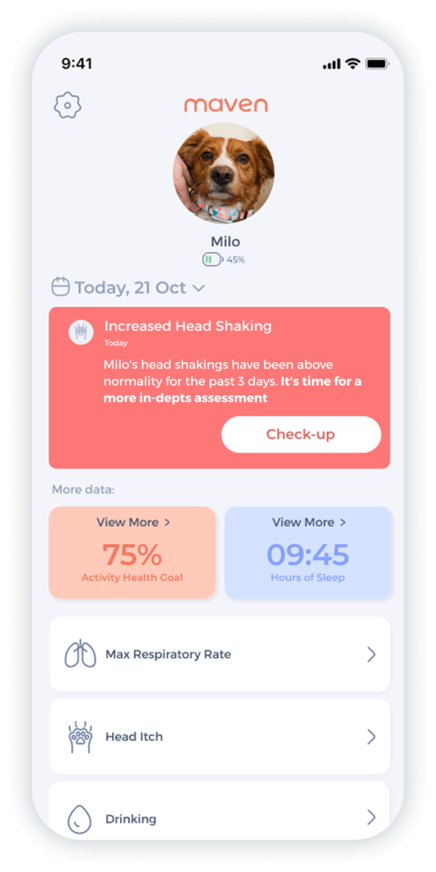
Monitor heart rate, respiratory rate, activity & rest, drinking, itch behavior.
Monitoring is crucial, be it proactively or as part of a disease management plan, and you typically need to observe the pup’s resting respiratory rate (RRR). You can do that with a dog health tracker, like the one Maven Pet offers, which can track RRR.
The pup wears our collar that actively tracks this and other health metrics, and you get insights through the pet health app.
Bottom Line
Heart murmur can be innocent or more serious, and it’s crucial to go to the vet if the murmur is louder and doesn’t go away as the pup grows.
Moreover, proactive monitoring can help you detect a murmur in the first place, and it’s also key as part of long-term management in cases of congenital heart disease. You can do all that with the Maven Pet pet health tracker.
If you’re interested, subscribe and order your Maven pet collar today to start actively monitoring your pup’s health.
Maven Pet focuses on improving the quality of life of our pets with technology, using artificial intelligence (AI) to enable proactive pet care. By accurately collecting and monitoring pet data 24/7 and flagging any irregularities, Maven Pet empowers pet parents and veterinarians to stay ahead of potential health issues, ensuring the well-being and longevity of our beloved companions.