
How Do Dogs Get Heartworm Disease? Prevention & Protection Tips (Vet Verified)

Heartworm disease plagues over 1.2 million dogs in the US, according to a survey by the American Heartworm Society (AHS), with 50,000 additional cases each year. It’s a serious and potentially life-threatening condition, and maybe the worst part of it all is that, by the time the clinical signs emerge, the disease has already developed and spread. Our goal today is to explain how do dogs get heartworm disease, the associated symptoms, and treatments, so you can work on prevention and know what to do if the disease strikes.
Key takeaways:
- Heartworm disease is caused by Dirofilaria immitis and spreads through mosquito bites.
- The disease damages the heart and lungs slowly, often before symptoms are obvious.
- Signs like coughing, fatigue, and breathing changes usually appear in later stages.
- Treatment is effective but lengthy, risky, and far harder than prevention.
- Tracking changes in activity and resting breathing via Maven Pet’s tracker can help spot problems earlier.
How Do Dogs Get Heartworm Disease?

Heartworm disease is a condition caused by a parasitic worm called Dirofilaria immitis, and dogs get it from mosquito bites. Plain and simple. Here’s how it works. When an infected mosquito bites a dog, it injects microscopic microfilariae. These become infected larvae over 10 to 14 days. Then, when the mosquito bites another dog, it spreads those larvae through the bite.
The larvae will develop into full-fledged adult heartworms in about 6-7 months, which will then mate and release their offspring into the bloodstream, completing their vicious cycle and setting off a silent infection that can smolder for months before anyone notices a problem. The worms going for the heart is why we call them heartworms.
It’s crucial to note that heartworms are only spread through mosquito bites.
Why Heartworm Disease Is So Dangerous
Heartworms damage a dog’s body by living inside the heart and major blood vessels, where they interfere with normal blood flow. As they grow, they crowd these vital areas, disrupt blood flow, and force the heart to work overtime just to keep up.
What makes this especially troubling is how sneaky the disease can be. Sneakier than probably any other dog heart disease. Pups often seem perfectly fine for months while internal damage is quietly building.
By the time coughing, low energy, or breathing trouble show up, the worms have usually been there a while, and treatment becomes more complicated and risky.
“I got the Maven sensor for my 14-year-old Chihuahua mix with heart and trachea issues. It gave me back peace of mind – I can track her RRR, BPM, drinking, and activity anytime and know instantly if something’s wrong. Highly recommend!”

★★★★★
Chiara De Luca
Titti
Signs of Heartworm Disease in Dogs
“Heartworm disease often develops silently. Subtle increases in breathing rate or reduced activity can be early clues that something isn’t right.” — Carolina Domingues, DVM, Veterinarian at Maven Pet
Here are the most common signs of heartworm disease in dogs:
- A persistent, soft cough, especially after activity
- Low stamina during walks or playtime
- Decreased appetite and gradual weight loss
- Labored or rapid breathing
- Swollen belly from fluid buildup in advanced cases
- Collapse or weakness, which is a medical emergency
The thing with these symptoms is that their severity is directly related to the number of worms in the dog’s body. The higher the so-called worm burden, the more serious the symptoms. In fact, the disease has four classes, determined by symptoms.
For example, Class 1 includes only mild symptoms, such as an occasional cough. Class 2 entails tiredness after an activity, while Class 3 is where we start to see signs of potential heart failure, a persistent cough, and overall deteriorating health. Class 4 is known as the caval syndrome. It’s a life-threatening condition that is caused by a vast number of worms blocking the blood flow, and surgical removal is the only treatment.
How Heartworm Disease Progresses Over Time
After an infected mosquito bite, immature heartworm larvae enter a dog’s bloodstream and slowly make their way through the body. Over several months, they mature and settle in the heart and the nearby blood vessels of the lungs, where they begin to interfere with circulation.
At this stage, there are usually no symptoms. As the worms grow larger and multiply, damage becomes harder to hide. Blood flow is restricted, and lung tissue becomes inflamed, so the heart grows weaker by the day. Without treatment, there’s a looming heart failure.
Dog Heartworm Disease Treatment: What to Expect

The main goal of dog heartworm disease treatment is to eliminate the worms while protecting the heart and lungs. This two-sided approach is essential because removing all the words at once, though technically impossible, can also be dangerous to the dog’s health.
The most effective way to treat heartworm disease is with the FDA-approved drug Melarsomine dihydrochloride. The drug is administered in the back of your dog through a deep injection. Another medication, Advantage Multi for Dogs, is used to remove microfilariae from a dog’s bloodstream.
These meds are not only expensive but can be toxic for dogs and cause serious conditions, such as blood clots, so the treatment should be done under the watchful eye of your vet. Note that after the treatment, worms start to decompose, so for the body to absorb them, the dog should rest completely. No exercise is allowed, and if you are not able to keep an eye on the dog throughout the day, a dog health tracker can give you a good overview of their activity levels.
Prevention & Year-Round Protection
When it comes to heartworm disease, prevention really is the easy road. First of all, get your dog tested, potentially every year, and especially if they have been staying in areas with a known mosquito activity, like Florida. This way, you will know whether prevention is the way to go or whether you need to start treatment of your heartworm-positive pooch right away
Secondly, veterinarians rely on routine heartworm preventives to prevent immature worms from ever growing into adults that can cause trouble. Simple steps like dumping standing water outside, keeping mosquito nets in good shape, and just doing the regular screenings and tests can make a big difference.
How Maven Pet Helps Monitor Early Heartworm Changes
Early heartworm signs are easy to miss because those slightly shorter walks or lower energy can feel “off,” but it can be hard to explain. It just could be nothing. To help get doubt out of the equation, pet owners rely on Maven Pet’s pet health tracker.

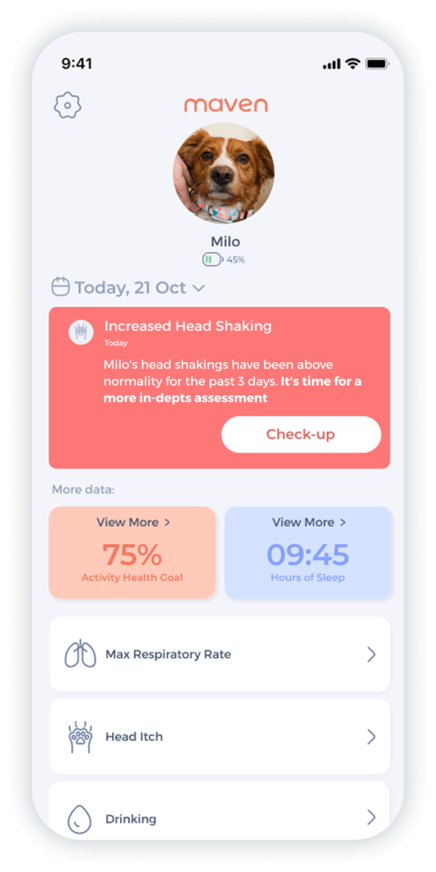
Monitor heart rate, respiratory rate, activity & rest, drinking, itch behavior.
The lightweight collar sensor tracks your dog’s daily movement and turns it into simple, readable insights in its pet health app, such as activity bursts and rest periods. By learning your dog’s personal baseline, it highlights meaningful drops in activity or a growing lethargy over time, rather than relying on generic step counts.
Maven also automatically tracks the resting respiratory rate, a key indicator of heart and lung health. It measures subtle chest movement only when your dog is truly at rest, then flags patterns like repeated high readings or abnormal trends.
Conclusion
Heartworm disease may start with a single mosquito bite, but its impact on a dog’s heart and lungs can be serious if it goes unnoticed. Because early signs are subtle, awareness and consistency matter more than with other conditions, so you should double down on year-round prevention and routine testing to stay in the clear. Tools like Maven Pet add another layer of support by helping owners spot changes in activity and resting breathing sooner, giving clearer insight to share with their veterinarian. When it comes to heartworm, earlier attention can make all the difference.
Maven Pet focuses on improving the quality of life of our pets with technology, using artificial intelligence (AI) to enable proactive pet care. By accurately collecting and monitoring pet data 24/7 and flagging any irregularities, Maven Pet empowers pet parents and veterinarians to stay ahead of potential health issues, ensuring the well-being and longevity of our beloved companions.