
Congestive Heart Failure in Dogs: Stages, Signs & Care (Vet Verified)

Receiving a diagnosis of heart disease or congestive heart failure (CHF) for your furry friend is frightening.
As a pet parent, you are likely searching for answers about what to expect, the best treatment options, and how to keep your dog comfortable. CHF in dogs is incurable, but it can be managed.
Understanding the signs of congestive heart failure in dogs, the different dog heart failure stages, and what good supportive care looks like will empower you to provide the best possible life for your dog.
This vet-backed guide walks you through the progression of this common ailment and highlights the crucial role of real-time monitoring.
Key Takeaways
- Congestive Heart Failure in dogs is the clinical endpoint of severe heart disease, where the heart can no longer pump blood effectively, leading to fluid backup in the lungs and/or abdomen.
- The early signs of Congestive Heart Failure are increased sleeping, less exercise tolerance, and persistent cough.
- The most important home indicator for worsening CHF is an increase in resting respiratory rate (ideally remaining below 30 breaths per minute).
- Early diagnosis and treatment can significantly improve a dog’s quality of life and longevity.
- Using a pet health tracker can help you detect the symptoms early on and take life-changing action.
What Is Congestive Heart Failure in Dogs?

Congestive Heart Failure is not a disease itself, but rather the advanced manifestation of preexisting dog heart disease (like Mitral Valve Disease or Dilated Cardiomyopathy).
Simply put, CHF occurs when your dog’s weakened heart can no longer efficiently circulate blood through the body.
This failure causes blood pressure to build up, forcing fluid to leak out of the blood vessels and into surrounding tissues, a process called congestion.
Dog Heart Disease Progression Explained
How does heart disease lead to CHF?
Most cases of CHF are caused by two primary forms of acquired heart disease:
- Chronic Valvular Disease (CVD): A progressive condition where one or more heart valves (most commonly the mitral valve) leak. This is the most common heart disease in dogs, especially small breeds.
- Dilated Cardiomyopathy (DCM): A disease of the heart muscle that results in an enlarged, weakened heart that cannot contract forcefully. This is more common in large breeds.
Over time, the heart tries to compensate for the leaks or weakness by beating faster and getting thicker.
But eventually, these compensatory mechanisms fail, leading to fluid accumulation and the onset of the clinical signs of CHF.
What Are the Signs of Congestive Heart Failure in Dogs?
Initial symptoms are often subtle, which is why monitoring is absolutely necessary.
Subtle and Early Signs
- Your dog tires more quickly on walks or during play. They may lag behind or refuse to go as far as they used to.
- A soft, persistent cough, often worse after physical activity, excitement, or when they wake up.
- Struggling to get comfortable, especially at night. They may prefer to sleep sitting up or with their head elevated.
- Muscle mass loss, especially along the back.
Critical Signs of Worsening CHF
These symptoms point to significant fluid buildup:
- Resting Respiratory Rate (RRR) above 35 breaths per minute while resting.
- Breathing Difficulties
- Coughing with white or pink froth
- Loss of consciousness
- Swollen abdomen often giving the dog a barrel-chested appearance.
- Blue-tinged gums
“I got the Maven sensor for my 14-year-old Chihuahua mix with heart and trachea issues. It gave me back peace of mind – I can track her RRR, BPM, drinking, and activity anytime and know instantly if something’s wrong. Highly recommend!”

★★★★★
Chiara De Luca
Titti
Congestive Heart Failure in Dogs Stages
Veterinarians use a staging system developed by the American College of Veterinary Internal Medicine (ACVIM) to classify the severity of congestive heart failure in dogs.
- Stage A: Dogs at high risk for developing heart disease but show no structural changes to the heart.
- Stage B1: Heart disease is present, but the heart is not yet enlarged, and the dog is asymptomatic.
- Stage B2: Heart disease is present, the heart has become enlarged, but the dog is still asymptomatic.
- Stage C (Clinical CHF): The dog has structural heart disease and is currently showing clinical signs of congestive heart failure.
- Stage D (Refractory CHF): End stage congestive heart failure in dogs. Clinical signs of CHF persist despite maximum conventional medical management.
End Stage Congestive Heart Failure in Dogs: What to Expect
Stage D, or refractory CHF, is the end stage congestive heart failure in dogs. At this point, the dog’s quality of life becomes the primary concern.
- Medication: Vets constantly adjust high-dose diuretics and heart drugs to manage fluid buildup.
- Crises: Expect frequent, severe breathing episodes that require emergency care and oxygen.
- Rapid Decline: Your dog’s strength and appetite will wane rapidly.
- Comfort Focus: The goal shifts entirely to ensuring your dog is comfortable and pain-free. Open discussions with your vet about palliative care and humane euthanasia are essential during this difficult time.

Treatments & Home Support for CHF
Managing CHF is a two-part effort to control fluid and support the heart:
Veterinary Treatment
- Diuretics: the core drugs to remove excess fluid from the lungs and body.
- Pimobendan: strengthens heart contractions and eases blood flow.
- ACE Inhibitors: reduce the pressure the heart pumps against.
Essential Home Support
- Maintain a low-sodium diet to reduce fluid retention.
- Ensure gentle, limited exercise only, strictly avoiding strenuous activity.
- Keep the environment calm to minimize stress, which can strain the heart.
How Maven Pet Helps Monitor CHF Symptoms in Real Time
“The earlier we detect heart disease and track changes in heart and breathing rates, the better chance a dog has for a longer, more comfortable life.” Joana Babo, DVM, Veterinarian at Maven Pet
Early detection can help your pet live longer. And the best way to ensure no subtle symptom goes past you is using a dog health tracker like Maven Pet.

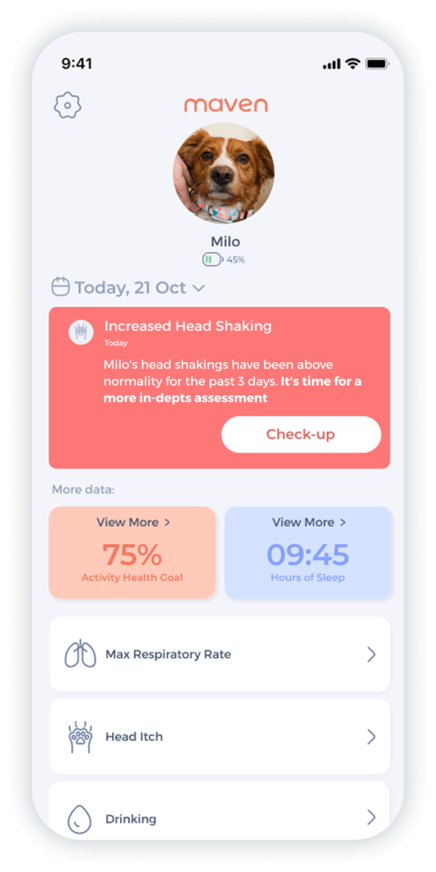
Monitor heart rate, respiratory rate, activity & rest, drinking, itch behavior.
The Maven Pet Health Monitor allows you to capture real-time, objective data, connecting medical guidance with daily home care.
- Monitor Resting Respiratory Rate: Maven Pet provides a baseline and tracks subtle, sustained increases in your dog’s RRR.
- Track Heart Rate: Provides objective data on heart rate changes.
- Identify Restless Nights: Tracks nighttime restlessness, a key symptom of increased fluid in the lungs (Stage C CHF).
- Activity Monitoring: Helps you adhere to your vet’s prescribed activity level, ensuring your dog is not overexerting themselves.
- Share Data with Your Vet: All data is compiled into easy-to-read reports you can share through the pet health app, allowing your vet to make data-backed adjustments to medication quickly.
Takeaways Recap
- Pay close attention to subtle shifts in exercise tolerance and sleep comfort.
- Learn how to check your dog’s resting respiratory rate and monitor it daily.
- Leverage technology like the Maven Pet Health Monitor for objective, real-time data to spot early changes.
- Follow all medication and diet instructions exactly and communicate any concerns immediately.
Maven Pet focuses on improving the quality of life of our pets with technology, using artificial intelligence (AI) to enable proactive pet care. By accurately collecting and monitoring pet data 24/7 and flagging any irregularities, Maven Pet empowers pet parents and veterinarians to stay ahead of potential health issues, ensuring the well-being and longevity of our beloved companions.