
Ringworm in Dogs: Signs, Causes & Prevention (Vet Verified)

If you’ve noticed a patchy, circular bald spot on your dog’s skin, or found a similar-looking rash on yourself, ringworm may be the first thing that comes to mind. Despite the name, ringworm has nothing to do with worms. It’s a fungal infection, and understanding what it is, how it spreads and how to prevent it can make a real difference for your dog and your entire household. Let’s learn more about ringworm in dogs.
Ringworm in Dogs – The Short Answer
Ringworm in dogs is a contagious fungal skin infection caused by dermatophyte fungi, not a worm. It infects the hair, skin and nails, causing circular patchy hair loss, scaling and crusting. It can spread to other pets and to people. Early recognition and veterinary diagnosis are important for limiting its spread.
Key Takeaways
- Ringworm in dogs is a fungal infection, not a parasitic one. The name is misleading
- It is caused by fungi of the genera Microsporum and Trichophyton, the most common being Microsporum canis
- Signs include circular patches of hair loss, scaling and crusting, but some dogs show no symptoms at all
- Ringworm is zoonotic, which means it can be passed between dogs, cats and people
- Puppies, elderly dogs and immunocompromised dogs are at highest risk
- Early diagnosis and prevention of spread to other animals and family members is essential
What Is Ringworm in Dogs?

Despite its name, ringworm is not caused by a worm, but by a fungal skin infection. The medical term is dermatophytosis and it is caused by a group of fungi called dermatophytes that infect keratinized tissues (hair, skin and nails).
The most common fungi responsible for ringworm in dogs are Microsporum canis, Microsporum gypseum and Trichophyton mentagrophytes. Of these, M. canis is by far the most frequently identified. Dermatophytes are classified by their natural habitat: zoophilic species, like M. canis, are adapted to animals; geophilic species, like M. gypseum, are primarily found in soil; and anthropophilic species are primarily associated with humans.
Ringworm is considered a self-limiting disease in otherwise healthy dogs, meaning the immune system will eventually clear it without treatment. However, due to its highly contagious nature, treatment is strongly recommended, not only to speed up recovery, but crucially to prevent spread to other animals and people in the household. Left untreated, ringworm poses a significant risk to everyone in contact with the affected pet, including humans.
Can Dogs Get Ringworm?
Yes. Dogs of all ages, breeds and sizes can get ringworm. However, ringworm is most common in puppies, older dogs and dogs with a compromised immune system. Dogs in poor condition, those under environmental stress or those receiving immunosuppressive medications are also at increased risk.
Certain breeds appear more susceptible than others. Yorkshire Terriers are consistently overrepresented in ringworm cases, as are working and hunting breeds such as Jack Russell Terriers, Labrador Retrievers, German Shepherds and Beagles, likely due to their increased contact with contaminated soil during outdoor activities.
“I got the Maven sensor for my 14-year-old Chihuahua mix with heart and trachea issues. It gave me back peace of mind – I can track her RRR, BPM, drinking, and activity anytime and know instantly if something’s wrong. Highly recommend!”

★★★★★
Chiara De Luca
Titti
How Do Dogs Get Ringworm?
Ringworm spreads through direct contact with an infected animal or human, or through contact with contaminated objects such as grooming equipment, bedding, collars, kennels or contaminated soil. The fungal spores are hardy and can survive on surfaces and in the environment for several months, reportedly up to 18 months, which makes environmental contamination an important factor in re-infection and spread.
After contact with infective spores, signs of infection typically develop within 1 to 3 weeks. Not every exposure leads to infection. The factors that increase susceptibility include skin microtrauma (scratches, cuts, insect bites), humidity and a weakened immune system.
Common sources of exposure:
- Direct contact with an infected dog, cat or person
- Shared grooming equipment, brushes or bedding
- Contaminated kennel or shelter environments
- Contact with infected soil (particularly for M. gypseum)
- Contact with infected rodents or their nests (for Trichophyton species)
What Does Ringworm on Dogs Look Like?
The classic appearance of ringworm is a circular, bald patch 1 to 4 cm in diameter, where hair is broken at the base creating a shaved appearance. Pale, powdery scales typically occupy the center of the lesion, with a reddened ring at the edges. Lesions most commonly appear on the head, ears, muzzle, tail and front paws.
However, not all ringworm cases look like this. Signs can include:
- Patchy or irregular hair loss, in one area or multiple locations
- Scaling or crusting of the skin
- Reddened or darkened skin
- Broken or weak hairs and a poor coat appearance
- Nail changes, that may become misshapen or brittle
Importantly, some dogs are subclinically infected which means they carry the fungus and can transmit it without showing any visible signs of disease. This is one reason ringworm can be easy to miss and why diagnosis should not rely on appearance alone.
“Ringworm can spread quickly between pets and people, and managing it well requires treating not only the affected pet, but also the environment where they live in.” — Joana Babo, DVM, Veterinarian at Maven Pet
Is Ringworm Contagious to Humans or Other Pets?

Yes, ringworm is a zoonotic disease, meaning it can be transmitted between animals and people. It is primarily spread through contact with the hair coat or skin lesions of an infected animal, or through contact with contaminated surfaces and objects in the environment.
People at greatest risk include young children, the elderly, pregnant women and those with compromised immune systems. In immunocompetent adults, ringworm typically causes manageable skin lesions that are treatable and curable.
If ringworm is suspected or confirmed in your dog, everyone in the household should monitor themselves for skin changes and consult a healthcare provider if needed. Dogs can act as sentinels for human disease. A diagnosis in your pet is a reason to pay attention to everyone else in the home too.
How Is Ringworm Diagnosed?
Ringworm can look similar to several other skin conditions, including bacterial skin infections, allergies and mange, which is why a veterinary diagnosis is essential before treatment begins. Ringworm is commonly misdiagnosed and clinical signs alone are not sufficient to confirm it.
- Wood’s lamp: a UV light that causes M. canis infected hairs to fluoresce yellow-green; useful as a quick screening tool but not definitive, as not all strains fluoresce
- Fungal culture (DTM): the most widely used confirmatory test; a toothbrush is combed through the coat and the sample is cultured on a special medium; results typically take 7-14 days but cultures should be held up to 21 days
- Direct microscopic examination: hairs can be examined under a microscope for fungal spores
- PCR testing: can detect fungal DNA, though a positive result does not always confirm active infection
- Skin biopsy: used for nodular or atypical presentations
How Can You Prevent Ringworm in Dogs?
Prevention focuses on reducing exposure, limiting spread and maintaining a clean environment:
- Avoid contact with infected animals: keep your dog away from dogs showing signs of hair loss or skin lesions
- Do not share grooming equipment: brushes, combs and bedding should not be shared between dogs at group events or kennels
- Screen new pets before introducing them to the household: even dogs with no visible signs can carry the fungus
- Disinfect your home environment: fungal spores can survive for months; use dilute bleach (1:10) on hard surfaces and steam cleaning on fabrics; note that chlorhexidine is not effective as an environmental decontaminant
- Use gloves and protective clothing when handling a dog suspected of having ringworm and wash hands thoroughly afterwards
- Quarantine infected dogs from other household pets during treatment until cultures confirm clearance
How Maven Pet Helps
While ringworm itself doesn’t cause obvious itching, other skin conditions that may look similar or occur alongside it, often do. Maven can help flag these by detecting increases in head scratching and night restlessness, both early behavioral signals that something may be irritating your dog’s skin. It also monitors activity levels, heart rate and resting respiratory rate continuously, building a personalized baseline and alerting you when your dog deviates from their normal patterns so you can look closer before a problem escalates.

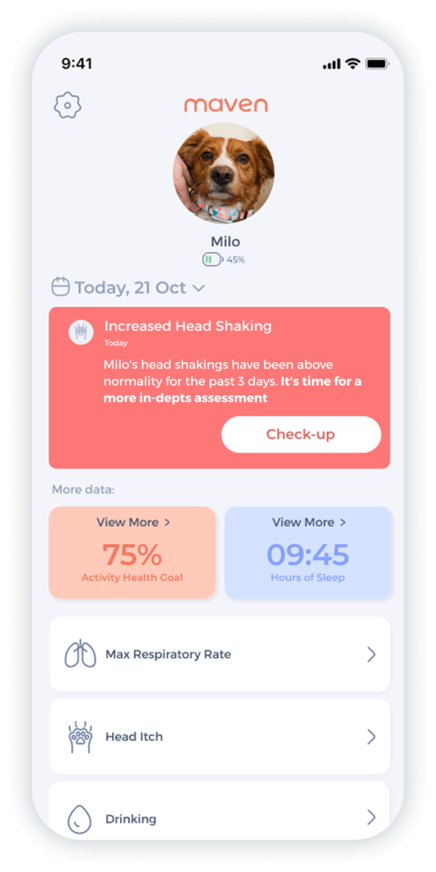
Monitor heart rate, respiratory rate, activity & rest, drinking, itch behavior.
For ringworm specifically, where management depends on consistency over weeks of treatment, the Maven pet health app becomes a powerful companion tool as it allows you to:
- Set medication reminders: antifungal treatment often runs for several weeks; Maven helps ensure no doses are missed
- Log vet appointments and follow-up culture tests: essential checkpoints to confirm the infection has fully cleared
- Record clinical symptoms and events: note when lesions appear, change or begin to resolve; these observations are cross-referenced with Maven’s sensor data on activity, sleep, heart rate and resting respiratory rate to generate personalized health insights
- Track behavioral changes over time: log any shifts in your dog’s energy or sleep as events, giving your vet a fuller picture at each consultation
The Maven pet health tracker combined with a dog health tracker means you’re never relying on memory alone. For dogs prone to dog skin allergies or recurring skin issues, having a structured, data-informed record of symptoms, treatments and responses, paired with Maven’s ongoing monitoring of vitals, behaviors, activity and sleep, makes every vet conversation more informed and every decision better supported.
FAQ (Vet-Reviewed)
Yes, dogs of all ages can develop ringworm. Puppies, senior dogs and immunocompromised dogs are most vulnerable, as are certain breeds including Yorkshire Terriers and working or hunting breeds.
Dogs get ringworm through direct contact with an infected animal, person or contaminated object such as grooming equipment, bedding or soil. The fungal spores are resilient and can survive in the environment for months.
Ringworm typically appears as circular patches of hair loss 1-4 cm in diameter, with broken hairs, powdery scales and a reddened edge. The majority of dogs don’t show any discomfort, and some dogs may not even show visible signs at all while still being contagious.
Yes, ringworm is a zoonotic infection that can pass between dogs and people. The risk is highest for young children, the elderly and immunocompromised individuals. If your dog is diagnosed, monitor all household members for skin changes and consult a healthcare provider if needed.
In healthy dogs, ringworm is usually self-limiting and may resolve on its own over several months, even though treatment is highly recommended. With veterinary treatment, recovery is faster and the risk of spreading to other pets and people is significantly reduced. Treatment should continue until fungal cultures confirm the infection has cleared.
Conclusion
Ringworm in dogs is a common, contagious and entirely fungal condition. It can be mild or subtle, easy to miss, and quick to spread to other pets and people in the household. Recognizing the early signs, getting a proper veterinary diagnosis and treatment, and acting promptly to limit environmental contamination are the most effective ways to manage it. Staying consistent with treatment, tracking progress over time and keeping your vet informed at every step gives your dog the best chance of a full and speedy recovery.
Maven Pet focuses on improving the quality of life of our pets with technology, using artificial intelligence (AI) to enable proactive pet care. By accurately collecting and monitoring pet data 24/7 and flagging any irregularities, Maven Pet empowers pet parents and veterinarians to stay ahead of potential health issues, ensuring the well-being and longevity of our beloved companions.