
Heart Murmur in Senior Dogs: Signs & Stages (Vet Verified)

Hearing that your senior dog has a heart murmur can be unsettling, but it doesn’t have to be a cause for immediate alarm. Many older dogs live comfortably with a murmur for years, especially when it’s caught early and monitored carefully. Understanding what a heart murmur means, how it can progress and what signs to watch for is the best thing you can do for your dog.
Heart Murmur in Senior Dogs – The Short Answer
A heart murmur in senior dogs is an abnormal heart sound caused by turbulent blood flow within the heart. It can range from a benign finding to a sign of underlying heart disease. While many senior dogs live well with a murmur for years, progression to heart failure is possible, making regular monitoring and veterinary check-ups essential.
Key Takeaways
- A heart murmur in senior dogs is graded on a scale of I-VI based on loudness, but grade alone does not determine severity or prognosis
- The most common cause in older small-breed dogs is myxomatous mitral valve disease (MMVD); in large breeds, dilated cardiomyopathy (DCM) is also a consideration
- Many dogs live comfortably with a murmur for years, but some progress to congestive heart failure
- Key warning signs of progression include increased resting respiratory rate, coughing, exercise intolerance and fatigue
- Continuous monitoring of resting respiratory rate, activity and heart rate is one of the most effective tools for catching early deterioration
What Is a Heart Murmur in Senior Dogs?

A heart murmur is an abnormal heart sound caused by turbulent blood flow within the heart. In most cases, your veterinarian will detect it during a routine examination using a stethoscope, and often before any symptoms are visible.
Murmurs are graded on a scale from I to VI based on loudness. A Grade I murmur is very soft and may only be heard in one location, while a Grade VI murmur is very loud and can even be felt when placing a hand on the chest. Importantly, the loudness of a heart murmur does not always correlate directly with the severity of the disease. A louder murmur does not automatically mean a worse prognosis.
Murmurs are broadly classified as either pathological (caused by structural heart disease) or nonpathological (not associated with a structural problem). In senior dogs, murmurs due to adult-onset heart disease are much more prevalent than congenital murmurs, and most newly detected murmurs in older dogs are considered pathological until proven otherwise.
+11%
Heart rate rise from
normal aging alone
2.5×
More likely chronically
elevated with heart issue
+8.9 bpm
Typical jump with
a known heart condition
Normal aging nudges a dog’s resting heart rate up gradually, about 11% higher by the advanced senior years. A known heart condition does more: affected dogs run up to 8.9 bpm faster than healthy dogs the same size, and are 2.5 times more likely to sit chronically elevated rather than just having the occasional high reading. Aging explains a little of the rise. A heart condition explains a lot more of it.
Source: Maven Pet internal data, 2,382 dogs tracked continuously.
See how Maven tracks heart rate→What Causes Heart Murmurs in Older Dogs?
The cause of a murmur in a senior dog depends heavily on size and breed:
- Myxomatous mitral valve disease (MMVD): the most common cause of heart murmurs in older dogs, particularly small breeds under 44lb. The mitral valve thickens and begins to leak, creating turbulence. MMVD should be suspected in middle-aged or older dogs generally weighing less than 44lb
- Dilated cardiomyopathy (DCM): more common in large and giant breeds, in which the heart muscle weakens and chambers enlarge. Murmurs caused by DCM are generally softer
- Bacterial endocarditis: a bacterial infection that localizes on a heart valve, causing murmurs that may coincide with other systemic signs
- Extracardiac causes: conditions such as anemia, low blood protein, fever or hypertension can create functional murmurs without structural heart disease being present
Geriatric small-breed dogs with systolic murmurs loudest over the left apex most commonly have MMVD, while in medium and large breeds, both MMVD and DCM should be considered.
“I got the Maven sensor for my 14-year-old Chihuahua mix with heart and trachea issues. It gave me back peace of mind – I can track her RRR, BPM, drinking, and activity anytime and know instantly if something’s wrong. Highly recommend!”

★★★★★
Chiara De Luca
Titti
What Are the Symptoms of Heart Failure in Senior Dogs?
In the early stages, a heart murmur in senior dogs typically causes no visible symptoms. Many murmurs are found incidentally during routine wellness exams. However, as the underlying disease progresses, symptoms may develop:
- Coughing: particularly at night or after resting, as the pet has been lying down for a longer period of time
- Increased or labored breathing: faster breaths, effort to breathe or open-mouth breathing not related with exercise
- Exercise intolerance: tiring quickly on walks or refusing activity they previously enjoyed
- Lethargy and fatigue: sleeping more, less engagement with surroundings
- Pale gums: a sign of reduced circulation
- Fainting or collapse: in more advanced cases
- Reduced appetite and weight loss
“Many senior dogs live comfortably with a heart murmur for years, but gradual changes in resting respiratory rate, activity or sleep patterns can indicate progression. Monitoring these trends consistently can help owners recognize worsening heart disease earlier.” – Joana Babo, DVM, Veterinarian at Maven Pet
By the time symptoms appear, heart disease is likely already progressing, which is why waiting for visible signs is not the most effective strategy.
How Do Heart Murmurs Progress Over Time?
Not all heart murmurs progress at the same rate. Some senior dogs maintain a stable murmur for years with no deterioration in quality of life. Others progress to congestive heart failure (CHF), a condition in which the heart is no longer able to pump out the volume of blood it receives effectively, causing fluid to accumulate in the body, most commonly in the lungs (pulmonary edema) or chest cavity (pleural effusion).
CHF can affect either side of the heart:
- Left-sided CHF: most commonly results in pulmonary edema, causing increased respiratory rate, difficulty breathing, coughing and exercise intolerance
- Right-sided CHF: most commonly results in fluid in the abdomen (ascites) or around the lungs, causing abdominal distension, exercise intolerance and breathing difficulty
Key clinical markers of progression include murmur grade increase, cardiac enlargement on imaging, and changes in resting respiratory rate. Regular echocardiographic monitoring is the most accurate way to assess disease progression.
What Are Signs of Late-Stage Heart Failure?

As heart disease reaches its most advanced stage, signs become more severe and quality of life is significantly affected. Late-stage or end-stage heart failure symptoms in senior dogs include:
- Persistent labored breathing even at rest
- Inability to settle or lie down comfortably
- Severe exercise intolerance, struggling with very short distances
- Marked abdominal swelling from fluid accumulation
- Extreme fatigue and weakness
- Loss of appetite and significant weight loss
- Restlessness or distress at night
Should heart disease progress to CHF, the prognosis is poor with an average survival time of 6 to 12 months. However, most dogs can be managed with medications and maintain a reasonable quality of life during that period. Honest, ongoing conversations with your veterinarian about your dog’s comfort and quality of life are essential at this stage.
How Can You Support a Senior Dog With a Heart Murmur?
A diagnosis does not mean your dog’s life changes overnight. There is a great deal you can do to support them:
- Attend regular veterinary check-ups: echocardiograms, chest X-rays and blood pressure monitoring allow early detection of progression
- Give medications as prescribed: the most commonly prescribed medications include diuretics such as furosemide, ACE inhibitors and pimobendan, which help manage fluid, reduce cardiac workload and improve heart function
- Monitor resting respiratory rate at home — count breaths per minute while your dog is relaxed or asleep. A normal dog at rest should breathe fewer than 30 times per minute; rates consistently above 30 to 35 breaths per minute warrant an immediate veterinary visit
- Maintain a healthy weight: excess body weight increases the heart’s workload
- Adapt exercise: gentle, regular activity is beneficial, but avoid strenuous exertion
- Reduce stress: a calm, comfortable home environment supports heart health
Why Monitoring Daily Changes Matters
One of the most important things an owner can do for a senior dog with a heart murmur is tracking daily patterns consistently. It is important to become familiar with your pet’s normal resting breathing rate and effort at home. Keeping a daily log can help you notice increases or changes from normal breathing.
Changes in resting respiratory rate, activity levels or sleep quality often appear before more obvious symptoms develop. Catching these early gives your veterinarian more time to adjust medications or intervene before a crisis occurs.
How Maven Pet Helps
The Maven pet health tracker is designed for exactly this kind of continuous, longitudinal monitoring, giving owners and vets the data needed to detect subtle changes in a senior dog’s condition before they escalate.

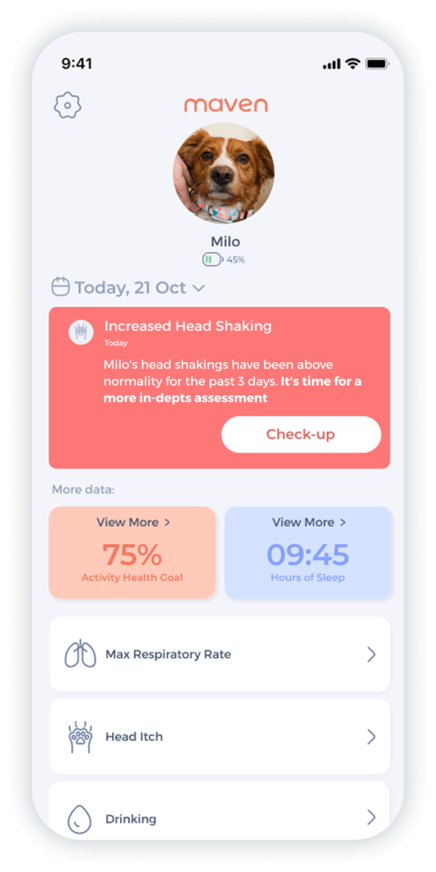
Monitor heart rate, respiratory rate, activity & rest, drinking, itch behavior.
Using the Maven pet health app with a dog health tracker, you can monitor:
- Dog respiratory rate tracker: resting respiratory rate is the single most important at-home indicator of worsening heart failure. Maven tracks it continuously and alerts you when it rises above your dog’s normal baseline and the 30 breaths/min threshold.
- Heart rate trends: detects cardiovascular irregularities that may signal disease progression
- Activity levels: identifies gradual declines in movement or stamina
- Rest patterns: flags increased sleep, nighttime restlessness or inability to settle comfortably
- Water intake: changes in drinking can occur with heart medications (such as diuretics) or as disease progresses
Unlike a vet visit snapshot, Maven builds a personalized baseline specific to your dog and alerts you when something deviates, giving you the information to act sooner. For dog heart disease, this level of continuous oversight is not a luxury, it’s one of the most practical tools available.
FAQ (Vet-Reviewed)
A heart murmur in senior dogs is an abnormal sound caused by turbulent blood flow within the heart. It may indicate underlying structural heart disease, most commonly mitral valve disease in small breeds, or in some cases an extracardiac condition. Not all murmurs lead to heart failure, but all warrant monitoring and veterinary follow-up.
Symptoms of heart failure in senior dogs include increased resting respiratory rate, labored breathing, coughing (especially at night), exercise intolerance, lethargy, pale gums, reduced appetite and in advanced cases, abdominal swelling and collapse. Many early signs are subtle, which is why tracking trends over time is so valuable.
Yes, many senior dogs live comfortably for years after a murmur is first detected, particularly when it is mild and caught early. The prognosis depends on the underlying cause, the grade of the murmur, and how well it is monitored and managed. Regular veterinary care and at-home monitoring significantly improve outcomes.
Late-stage heart failure signs include severe labored breathing even at rest, inability to settle or lie down, marked abdominal distension, extreme fatigue, near-complete loss of appetite and persistent distress. At this stage, quality-of-life discussions with your veterinarian are essential.
Contact your veterinarian if your dog’s resting respiratory rate is consistently above 30-35 breaths per minute, if you notice labored or open-mouth breathing, or if breathing seems to require visible effort. Any sudden worsening of breathing should be treated as an emergency.
Conclusion
A heart murmur in senior dogs is not a verdict. It is a signal to pay closer attention. Many dogs live well for years after diagnosis, especially with consistent monitoring, appropriate veterinary care and early intervention when changes occur. The key is not to wait for obvious symptoms. Small, gradual shifts in breathing, energy and rest patterns are often the earliest signs that something is changing, and the earlier those shifts are detected, the more options you have.
Maven Pet focuses on improving the quality of life of our pets with technology, using artificial intelligence (AI) to enable proactive pet care. By accurately collecting and monitoring pet data 24/7 and flagging any irregularities, Maven Pet empowers pet parents and veterinarians to stay ahead of potential health issues, ensuring the well-being and longevity of our beloved companions.