Cognitive Dysfunction In Dogs: Early Signs Owners Miss (Vet Verified)

If your older dog seems a little “off” lately, such as slower to respond, confused by familiar surroundings or restless at night, it can be tempting to chalk it up to normal aging. But these subtle shifts may be early signs of something more specific: cognitive dysfunction in dogs. Knowing what to look for and when to act, can make a real difference for your dog’s quality of life.
What Is Cognitive Dysfunction in Dogs?
Cognitive dysfunction in dogs is an age-related neurodegenerative condition similar to Alzheimer’s disease in humans. Early signs such as mild disorientation, sleep changes or reduced interaction are subtle and frequently mistaken for normal aging. Recognizing cognitive dysfunction early, and tracking behavioral changes over time, is key to slowing its progression.
Key Takeaways
- Cognitive dysfunction in dogs is a progressive, age-related brain condition affecting dogs typically from 8 years of age onward
- Early signs are subtle and commonly mistaken for normal aging, contributing to significant underdiagnosis
- The DISHAA framework captures the main behavioral domains affected: disorientation, social interaction, sleep, house soiling, activity and anxiety
- There is no cure, but early intervention with medication, diet, enrichment and monitoring can slow progression
- Continuously tracking sleep, activity and rest patterns can help detect early deviations before they become severe
Cognitive Dysfunction in Dogs, Explained

Cognitive dysfunction in dogs, also called canine cognitive dysfunction syndrome (CCDS), is a chronic, progressive neurodegenerative condition that develops with advancing age. It is considered the canine counterpart of Alzheimer’s disease in humans, sharing many of the same brain changes, including the accumulation of amyloid-beta plaques, oxidative damage and neuroinflammation.
The condition generally affects dogs from around 8 years of age, though the threshold can vary by size: larger breeds may show signs earlier, from around 6-7 years, while smaller breeds often develop symptoms between 8-10 years. Prevalence rises sharply with age, affecting approximately 19% of dogs aged 11-13 years, and up to 45% of dogs by age 15.
Despite how common it is, cognitive dysfunction is significantly underdiagnosed. Research suggests that less than 2% of affected dogs receive a formal diagnosis, largely because signs are frequently attributed to normal aging rather than a distinct medical condition.
−20%
Activity drop,
early senior years
−37%
Activity drop,
advanced senior years
Holds true
Even in dogs with
no diagnosed condition
Even in dogs with no diagnosed condition, daily activity drops meaningfully with age, about 20% lower once a dog reaches early senior years and 37% lower in advanced seniors compared to their adult baseline. That decline is normal aging, not automatically a red flag. A sudden or unusually steep drop outside that pattern is the one worth mentioning to your vet.
Source: Maven Pet internal data, life-stage comparison across tracked dogs.
See how Maven tracks activity→What Are the Early Signs Owners Often Miss?
The earliest signs of dog cognitive dysfunction are easy to overlook because they tend to be infrequent, mild and indistinguishable, at first glance, from the natural slowing down of an older dog. According to recent diagnostic guidelines, early signs in mild CCDS are subtle and low in frequency, with the dog generally still able to perform normal functions. Changes are frequently attributed to old age by caregivers and may be missed unless specifically screened for.
Early signs to watch for include:
- Nighttime restlessness: waking up, pacing, or seeming unsettled when they would normally be asleep
- Decreased daytime activity: less interest in walks, play, or interaction than usual
- Changes in social interaction: becoming either more clingy or more withdrawn than usual
- Subtle disorientation: going to the wrong side of a door, staring blankly, or appearing briefly “lost” in familiar spaces
- Reduced responsiveness: slower to react to their name or previously known commands
Research indicates that nighttime restlessness, decreased daytime activity and changes in social interaction are among the earliest signs to appear in the disease course, and often precede more obvious symptoms by months or even years.
“I got the Maven sensor for my 14-year-old Chihuahua mix with heart and trachea issues. It gave me back peace of mind – I can track her RRR, BPM, drinking, and activity anytime and know instantly if something’s wrong. Highly recommend!”

★★★★★
Chiara De Luca
Titti
What Are the Symptoms of Cognitive Dysfunction Syndrome in Dogs?
As cognitive dysfunction progresses, behavioral changes become more frequent, more severe and harder to dismiss. The main domains affected are captured by the acronym DISHAA:
- D – Disorientation: getting stuck in corners, not recognizing familiar people, seeming confused in familiar environments
- I – Impaired social interactions: reduced responsiveness to owners, aversion to petting, or conversely, increased attention-seeking
- S – Sleep disturbances: wandering or vocalizing at night, sleeping more during the day
- H – House soiling: urinating or defecating indoors despite being previously house-trained; also includes loss of previously learned commands
- A – Activity changes: restlessness, aimless pacing, or reduced engagement with the environment
- A – Anxiety: new fears, increased anxiety, or irritability
In moderate to severe stages, changes in house soiling and spatial disorientation become more prominent. These signs significantly affect both the dog’s welfare and the owner’s daily life, and are among the most common reasons owners ultimately consider euthanasia.
How Is Cognitive Dysfunction Different From Normal Aging?
This is one of the most important and most difficult questions for dog owners to answer. All older dogs slow down, sleep more and may be less playful. So how do you tell normal aging from cognitive dysfunction syndrome?
The key distinction lies in the nature and progression of the changes. Normal aging produces gradual, moderate shifts in energy or sensory acuity. Cognitive dysfunction produces changes in cognition and behavior, such as how a dog thinks, navigates, interacts, and responds, that progressively affect daily functioning.
A useful rule of thumb: if behavioral changes are impacting your dog’s ability to navigate their environment, recognize familiar people, maintain their normal sleep cycle, or keep their house-training, they deserve veterinary attention. Normal aging doesn’t take those away.
It’s also worth noting that CCDS is a diagnosis of exclusion. Similar signs can be caused by pain, arthritis, sensory decline, thyroid disorders, or other systemic conditions, all of which must be ruled out first.
What Causes Cognitive Decline in Dogs?

The single most significant risk factor for cognitive dysfunction is age itself. As the brain ages, neurons deteriorate, antioxidant systems weaken and proteins like amyloid-beta begin to accumulate, creating toxic conditions that impair cognitive function over time. These changes mirror those seen in human Alzheimer’s disease, which is why dogs are considered a valuable natural model for studying the condition.
Contributing factors include:
- Oxidative stress – age-related accumulation of free radical damage to brain tissue
- Amyloid-beta deposition – progressive buildup of protein plaques in the cortex and hippocampus
- Altered neurotransmitter function – changes in dopamine, acetylcholine and other brain chemicals involved in learning and memory
- Neuroinflammation – activated immune cells in the brain that accelerate neuronal damage
- Sex – female dogs may be at slightly higher risk, similarly to what is observed in human Alzheimer’s disease
There is currently no way to prevent CCDS entirely, but early detection and intervention remain the most effective means of slowing its progression.
When Should You Be Concerned?
Speak to your veterinarian if your senior dog shows any of the following, particularly if the changes are new, gradually worsening, or affecting daily life:
- Nighttime waking, pacing, or vocalization
- Getting lost or confused in familiar spaces
- Reduced response to their name or commands they previously knew
- Changes in their relationship with you (less affectionate or unusually clingy)
- Accidents in the house despite being reliably house-trained
- Unexplained restlessness or repetitive behaviors
Current guidelines recommend annual cognitive screening from 7 years of age, and every 6 months from age 10 onward. Early detection gives both you and your veterinarian the best chance to intervene before symptoms become severe. The most effective screening tools track changes in your dog’s behavior over time, but a single snapshot is rarely enough. Environmental enrichment, including food puzzles, sniff games, and regular mental stimulation, has been shown to help slow cognitive decline¹, particularly when combined with veterinary care.
¹ Coupland S, Reynolds H. Do dog owners recognise behavioural indicators of canine cognitive dysfunction and can environmental enrichment techniques slow its progression? The Veterinary Nurse. 2018;9(2):118–123.
“Cognitive dysfunction in dogs often develops gradually, and early signs like changes in sleep patterns or activity can be easy to overlook. Monitoring these trends consistently can help identify cognitive decline sooner and support better long-term care.” – Joana Babo, DVM, Veterinarian at Maven Pet
How Maven Pet Helps
Because cognitive dysfunction in dogs develops gradually and its early signs are so easy to miss, continuous behavioral monitoring is one of the most powerful tools available to dog owners today.
The Maven pet health tracker monitors your dog around the clock, building a personalized baseline for your dog and alerting you when patterns shift. The Maven pet health app paired with the dog health tracker and dog sleep tracker enables continuous monitoring of:
- Rest and sleep patterns: detects nighttime restlessness or disrupted sleep cycles, one of the earliest measurable indicators of cognitive decline
- Activity levels: identifies unexplained drops in movement or engagement throughout the day
- Heart rate trends: might flag changes that may reflect stress, confusion, or underlying discomfort
- Resting respiratory rate: helps identify underlying stress or physical discomfort that may accompany cognitive changes
- Personalized alerts: notifies you when your dog deviates from their own baseline, not just a population average

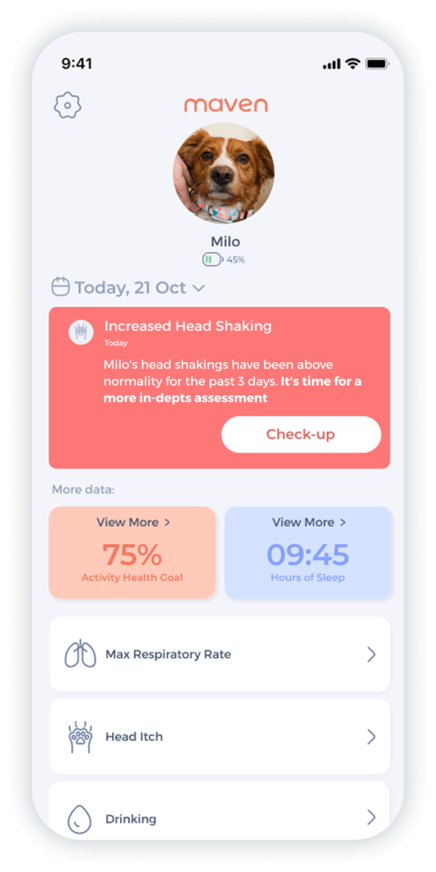
Monitor heart rate, respiratory rate, activity & rest, drinking, itch behavior.
Dogs with cognitive dysfunction often also experience dog arthritis and other age-related conditions that can complicate the clinical picture. Maven’s continuous data helps distinguish overlapping conditions and gives your vet a fuller picture of your dog’s day-to-day health. Nearly all veterinarians rely on patient history and behavioral changes to make a diagnosis – the kind of longitudinal data Maven provides is exactly what supports that process.
FAQ (Vet-Reviewed)
Cognitive dysfunction is a progressive, age-related neurodegenerative condition comparable to Alzheimer’s disease in humans. It causes gradual changes in brain function that affect behavior, memory, navigation, sleep and social interaction, typically beginning around 8 years of age.
Early signs include nighttime restlessness, decreased daytime activity, subtle disorientation in familiar spaces, changes in social interaction and reduced responsiveness to commands. These signs are mild and infrequent at first, making them easy to attribute to normal aging.
Cognitive dysfunction syndrome in dogs (CCDS) is the formal clinical name for canine dementia. It is defined as a chronic, progressive, age-associated neurodegenerative syndrome characterized by behavioral and cognitive changes across six domains: disorientation, social interaction, sleep, house soiling/memory, activity and anxiety (DISHAA).
Normal aging causes gradual, moderate changes in energy and sensory function. Dog dementia involves changes in cognition, such as how a dog navigates, recognizes, interacts and responds, that progressively affect daily functioning. If your dog is getting confused in familiar places, losing house training, or undergoing significant changes in their sleep-wake cycle, that goes beyond typical aging.
If your senior dog shows any new or worsening changes in behavior, particularly disorientation, nighttime restlessness, house soiling, or altered social interaction, schedule a veterinary visit.Current guidelines suggest cognitive screening should start at 7 years of age and be repeated every 6 to 12 months. Early detection offers the best opportunity for intervention.
Conclusion
Cognitive dysfunction in dogs is one of the most common and most underrecognized conditions affecting senior dogs. Its early signs are subtle, its progression is gradual and by the time behavioral changes become impossible to ignore, significant neurodegeneration has often already occurred.
Watching for early shifts in sleep, activity, social behavior and orientation, and tracking them consistently over time, gives you the best chance of catching cognitive decline before it becomes severe. With the right support, many dogs with CCDS can maintain a good quality of life for months or even years after diagnosis.
Maven Pet focuses on improving the quality of life of our pets with technology, using artificial intelligence (AI) to enable proactive pet care. By accurately collecting and monitoring pet data 24/7 and flagging any irregularities, Maven Pet empowers pet parents and veterinarians to stay ahead of potential health issues, ensuring the well-being and longevity of our beloved companions.