
Dog Heart Rate Monitor: What to Know Before Buying (Vet Verified)

If you’ve ever wondered whether your dog’s heart rate is normal or whether subtle changes could signal a health issue, you’re not alone. As wearable pet technology becomes more popular, many owners are researching whether a dog heart rate monitor can help them track their dog’s health more closely.
But how do these devices actually work? And can they really help detect health problems earlier?
Understanding what heart rate monitoring measures and how veterinarians use this information can help you decide whether this type of technology makes sense for your dog.
What Should You Know About a Dog Heart Rate Monitor?
A dog heart rate monitor is a wearable device that continuously tracks a dog’s heart rate throughout the day and night. By monitoring long-term trends rather than isolated readings, these devices can help identify early changes that may indicate stress, pain, overheating, or developing heart disease.
Key Takeaways
- A dog heart rate monitor tracks heart rate continuously rather than through occasional pulse checks.
- Continuous monitoring helps detect patterns and subtle changes in heart activity.
- Heart rate varies significantly depending on a dog’s size, age, and activity level.
- Long-term trends often provide more useful health insights than single readings.
- Wearable devices that track multiple health metrics provide a more complete picture of overall wellbeing.
What Is a Dog Heart Rate Monitor?

A dog heart rate monitor is a wearable device designed to continuously measure heart rate over extended periods of time. These devices typically attach to a dog’s collar or harness and use sensors to detect signals related to each heartbeat.
In veterinary medicine, continuous heart monitoring has long been used to diagnose cardiac rhythm abnormalities. Devices such as Holter monitors record a dog’s heart activity for 24 hours or longer while the dog goes about normal daily activities. Modern wearable devices apply the same principle to everyday health tracking, allowing owners to monitor heart rate trends outside the veterinary clinic.
How Does a Heart Rate Monitor for Dogs Work?
A heart rate monitor for dogs works by detecting physical signals produced by each heartbeat.
Depending on the technology used, sensors may measure:
- Electrical activity from the heart
- Subtle body movements caused by blood circulation
- Optical signals reflecting blood flow changes
Veterinary monitoring systems often track several vital signs simultaneously, including heart rate, respiratory rate and activity levels.
By collecting continuous data over time, wearable monitors can reveal patterns that may not appear during short veterinary visits.
When Should You Use a Dog Collar Heart Rate Monitor?
A dog collar heart rate monitor can be helpful in several situations, especially when veterinarians need to evaluate heart function outside the clinic environment.
Common scenarios include:
- Monitoring dogs with known heart disease
- Tracking recovery after cardiac treatment
- Investigating unexplained fainting or weakness
- Observing heart rate changes during exercise
- Monitoring senior dogs for early health changes
Veterinary cardiology teams often rely on continuous monitoring when evaluating arrhythmias or assessing treatment response.
Even for healthy dogs, long-term monitoring may provide useful insights into how heart rate responds to activity, stress or environmental changes, and may help identify early signs of undiagnosed heart disease.
“I got the Maven sensor for my 14-year-old Chihuahua mix with heart and trachea issues. It gave me back peace of mind – I can track her RRR, BPM, drinking, and activity anytime and know instantly if something’s wrong. Highly recommend!”

★★★★★
Chiara De Luca
Titti
What Is a Normal Heart Rate for Dogs?
A dog’s normal resting heart rate varies significantly depending on size, age, and overall fitness.
Typical resting ranges include:
| Dog Size | Heart Rate (bpm) |
| Small dogs (under 30 lbs) | 90–140 bpm |
| Medium dogs | 70–110 bpm |
| Large dogs | 60–90 bpm |
| Puppies (under 1 year) | 120–160 bpm |
For most adult dogs resting heart rate generally falls between 60 and 140 beats per minute.
Smaller breeds tend to have faster heart rates, while larger dogs usually have slower ones. However, the most important factor is understanding what is normal for your individual dog, a parameter that can be easily measured with a heart rate monitor like the Maven Pet health tracker.
Heart rate can naturally change based on:
- Exercise or excitement
- Stress or anxiety
- Pain or illness
- Temperature or environment
This is why veterinarians often focus on long-term trends rather than single readings when evaluating heart health.
Benefits of Continuous Monitoring vs Spot Checks

Traditional heart rate checks usually happen during veterinary visits or occasional pulse checks at home. While these provide useful information, they only capture a brief moment in time.
Continuous monitoring offers several advantages.
Trend detection
Subtle changes in heart rate patterns may occur days or weeks before visible symptoms appear.
Real-world conditions
Heart rate is measured while the dog goes about normal daily activities rather than during a stressful clinic visit.
Earlier warning signals
Research on veterinary monitoring technologies highlights how continuous physiological monitoring can help detect health changes earlier. These early insights may allow veterinarians to investigate potential problems sooner.
How Maven Helps Monitor Heart Health
Maven’s pet health tracker continuously monitors heart rate alongside other important health indicators.
Unlike occasional pulse checks, Maven measures heart rate throughout the day and night, building a personalized baseline for each dog.

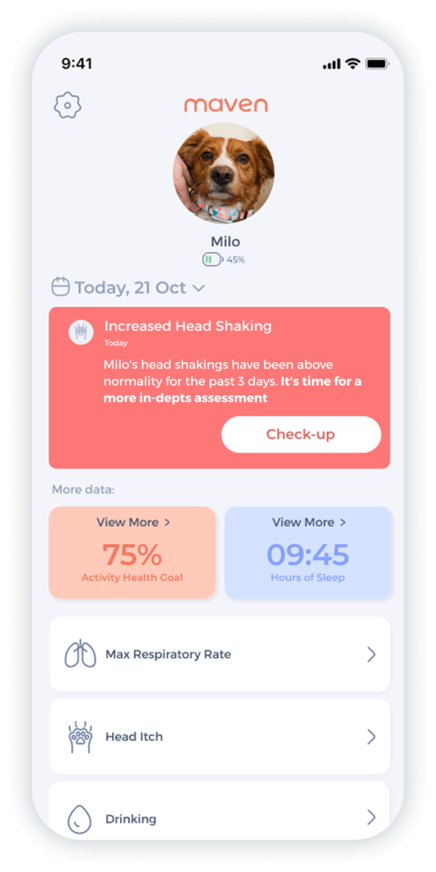
Monitor heart rate, respiratory rate, activity & rest, drinking, itch behavior.
Using the pet health app provided by Maven, owners can view long-term trends in:
- Heart rate
- Activity levels
- Sleep patterns
- Resting respiratory rate
- Head shaking behavior
- Drinking behavior
When heart rate patterns shift away from a dog’s normal baseline, Maven’s dog health tracker is able to identify the shifts and alert owners so they can investigate possible causes.
These changes may signal:
- Stress
- Pain
- Overheating
- Fatigue
- Developing cardiac conditions
Combined with other health metrics, continuous monitoring can help owners and veterinarians identify potential problems earlier, particularly in dogs at risk of heart disease.
FAQ (Vet-Verified)
Accuracy depends on the technology used. Veterinary monitoring systems and wearable sensors designed for continuous tracking can provide reliable heart rate trends over time.
Most adult dogs have a resting heart rate between 60 and 140 beats per minute, though smaller dogs usually have faster heart rates than larger breeds. Exercise, anxiety, pain or increased environmental temperature can lead to higher heart rates.
Healthy dogs do not necessarily require continuous heart rate monitoring, although they can benefit from it. Wearable devices can help owners understand long-term health trends and detect subtle physiological changes earlier.
Changes in heart rate patterns may appear before obvious symptoms develop. Continuous monitoring of heart rate and other health variables and behaviors can help identify these changes earlier and prompt veterinary evaluation.
Conclusion
A dog heart rate monitor can provide valuable insight into your dog’s health by tracking heart activity over time. While occasional pulse checks offer limited information, continuous monitoring reveals patterns that may indicate early health changes.
For pet owners interested in proactive health monitoring, especially those with senior dogs or breeds at higher cardiac risk, wearable technology offers a new way to understand what’s happening beneath the surface.
Because when it comes to heart health, small changes can be the earliest warning signs.
Maven Pet focuses on improving the quality of life of our pets with technology, using artificial intelligence (AI) to enable proactive pet care. By accurately collecting and monitoring pet data 24/7 and flagging any irregularities, Maven Pet empowers pet parents and veterinarians to stay ahead of potential health issues, ensuring the well-being and longevity of our beloved companions.